
ATTN: Small LSPs
Stop sleepwalking into a crisis: Take back quality and control with GECR
If you are a small LSP owner, you are seeing firsthand how the landscape of translation is changing. The larger players have set the rules of the game, pushing everyone toward high-volume, low-margin MT post-editing that treats translators like afterthoughts and delivers bland, generic output. While this may fit the workflows and budgets of giant agencies, it is causing quality, trust, and margins to vaporize at the boutique end of the market. It is a crisis quietly unfolding, and the time to wait it out is over.
The GAIT-Enhanced Collaborative Revision (GECR) workflow is a tactical answer to this challenge. It is a new way of running MTPE jobs that puts translators, project managers, and agency owners back in the driver’s seat. Instead of asking your team to clean up the mess left by black-box machine engines, you actively shape the draft before it ever reaches human post-editing. GECR transforms the relationship between man and machine, turns translators into valued revision experts rather than “fixers,” and unlocks higher productivity without sacrificing quality or control.
What is the GAIT-Enhanced Collaborative Revision workflow?
The GAIT-Enhanced Collaborative Revision (GECR) workflow is a team-based adaptation of the Generative AI Iterative Translation (GAIT) method, which was first developed for top freelance translators to boost quality, consistency, and efficiency all at once. GECR brings these benefits into the agency environment, giving both project managers and translators more control over the process and outcome.
Instead of leaving translators to fix generic, awkward machine translation output as in standard MTPE, GECR starts with the translator building a high-quality sample translation—called a “gold standard” anchor—that sets the specific style and terminology for the entire project. This anchor, along with client glossaries, project-specific instructions and/or TM matches, is used to guide the AI so the draft it produces already follows the human expert’s standards.
After the AI creates the main draft, the same translator revises and refines the text. Because this draft reflects their style and choices from the start, the work is smoother, faster, and far less frustrating. The result is a workflow that lets small LSPs deliver better translations quickly, with real teamwork, no expensive software, and much less hassle than traditional post-editing ever offered.
See the GAIT-Enhanced Collaborative Revision Workflow in Action!
Watch the following video for a step-by-step demonstration of the workflow.
Key Benefits of the GAIT-Enhanced Collaborative Revision Workflow for Small LSPs
1. Higher quality translations
By anchoring the AI to real translator samples and custom terminology, the workflow produces drafts that sound natural, flow well, and capture client-specific language choices.
2. Translator buy-in and retention
Translators are far more likely to trust, enjoy, and accept projects when they see their expertise reflected in the first draft. The process respects their voice and knowledge, making revision more satisfying and reducing the urge to bypass your workflow.
3. Tangible productivity gains
With cleaner drafts and less rework, translators work faster. Typical revision volume can increase while maintaining or improving quality. This efficiency can make even tough pricing discussions easier and less contentious.
4. Competitive positioning
You are no longer forced to compete only on price or rush jobs at the expense of quality. GECR lets you offer a genuinely differentiated service: high-volume, fast turnaround, and no compromise on accuracy or tone.
5. Lower risk, greater data security
The workflow is designed for confidential content and doesn’t lock you into inflexible, expensive platforms. You keep control of your data, and your translators can continue working in their own trusted CAT tools.
6. Minimal upfront investment
You don’t have to become an AI expert or buy new systems. The process adapts to your current tools and team. Once you understand the method, setup is quick and scalable.
7. More projects unlocked
The increased efficiency means you can take on work that might have been unprofitable or timing-prohibitive before. Quality stays high, so client satisfaction and repeat business go up too.
In short, GECR future-proofs your agency, strengthens your team, and lets you compete on real value—without racing to the bottom.
Steven handled a 175-page cross-border legal translation from Korean into English for us this year, delivering excellent work on time as he has done for us for many years. Prior to starting the project, he explained that, with our consent, he could use the GAIT Workflow, an AI-assisted translation process designed to help professional human translators work more efficiently while maintaining quality. As a reviewer of legal translations for nearly 20 years, I could see that his approach provided quality work in a quicker timescale than expected, but also required human knowledge, experience and input in order to achieve such a good result. Linguistico will certainly continue exploring this workflow as it provides an excellent end product for translators, LSPs and clients in the legal sector where “good enough” is simply not good enough.
Benefits of the GECR Workflow for Your Clients

1. Consistent, higher quality output
Clients receive translations that read smoothly and accurately from start to finish, with proper terminology, style, and tone. The workflow delivers results that feel more like original writing, not patchwork or “machine-sounding” text.
2. Quicker turnarounds without sacrificing quality
By empowering translators with clean, well-prepared drafts, projects get completed faster, but not at the expense of careful revision and attention to detail. Clients can expect accelerated delivery times on par with traditional MTPE workflows, especially on large or technical projects.
3. Accountability and transparency
Because the translator’s own work anchors the entire process, clients have clear insight into what quality to expect, and agencies can explain every step taken to safeguard that quality. This means fewer surprises and smoother revisions.
4. Security and confidentiality
Sensitive documents stay protected. The workflow allows for secure, direct access to the latest AI models, bypassing free public platforms that might risk client data.
5. More content delivered for the same budget
Greater efficiency means clients can often translate more material for the same investment. Content that was too costly or time-consuming to tackle with traditional workflows becomes feasible, letting clients expand their reach and get better value.
6. True partnership with language experts
Clients benefit from knowing real translators are deeply involved, not just “post-editing” at arm’s length. Their projects are handled by professionals, often on a long term basis, who care both about meaning and nuance, and who actually want the work to succeed.
In the end, the GECR workflow lets clients raise their expectations about quality without giving up on savings. It restores their relationship with you, letting you add more value in other ways too.
Benefits of the GECR Workflow for Translators
1. Meaningful, satisfying work
Instead of being asked to clean up awkward machine output, translators get to revise drafts that already reflect their style and understanding. Their gold standard sets the tone, so they feel like the real author, not just a fixer at the end of a broken process.
2. Greater control and influence
The translator is a key voice in defining project quality from the start, shaping decisions on terminology, style, and client preferences. This sense of ownership and respect just isn’t possible in traditional MTPE and restores the human touch to the translation process.
3. Higher productivity with less frustration
Because the drafts are cleaner and require fewer drastic changes, GECR projects demand less cognitive effort without feeling like quality is taking a back seat.
4. Transparent and fair compensation
Because the workflow is efficient and outcomes are better, rate discussions become more honest and predictable. Translators are not asked to do more work for less money or accept vague “post-editing” workloads.
6. Security, Privacy, and Respect for Tools
GECR doesn’t force the translator into new proprietary systems or unfamiliar processes. They can work in their own preferred CAT tool, further fostering a comfortable workflow.
With the GECR workflow, translators get to focus back on what they do best: ensuring clarity, nuance, and quality in the final product. At the same time, they become more competitive in an industry that’s rapidly changing.

How the GAIT-Enhanced Collaborative Revision Workflow Works
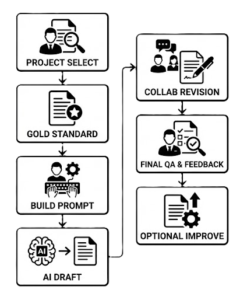
Step 1: Select the right project
Step 2: Create the “gold standard” anchor
Step 3: Build the anchor prompt
Step 4: Generate the AI draft
Step 5: Collaborative revision by the translator
Step 6: Final QA and feedback
Step 7: Optional improvements
In summary, the GECR workflow keeps human expertise at the center, with AI acting as an assistant rather than a substitute. This approach reduces drudge work, limits mistakes, and gives everyone more control over the final result.
Frequently Asked Questions about the GAIT-Enhanced Collaborative Revision Workflow
Is this just another type of machine translation post-editing (MTPE)?
No. Traditional MTPE hands you generic output from an engine and asks translators to mop up the mess. GECR uses a guided, translator-driven sample (the gold standard anchor) to make the AI output much cleaner and more predictable from the start. The translator is not fixing machine errors, but revising a draft that already reflects their expertise.
Does this workflow require special AI tools or software?
Not really. While tools like CotranslatorAI streamline the process and offer extra privacy, you can use most CAT tools to manage files and interact with the AI engine of your choice. The key is in the method—how you set up the gold standard anchor and prompt engineering—not expensive, locked-down software.
How much training will our team need?
Most of the adjustment is on the project management side: learning to build a solid prompt and select the right anchor text. Translators will find the revision process easier than normal MTPE. A short orientation is usually enough to get everyone started.
Will the workflow work for every project?
The biggest wins happen with structured content: manuals, patents, medical, and legal text. Highly creative projects, marketing copy, and odd-format files (like scanned PDFs) are less suited to this approach. Use GECR where consistency, terminology, and clarity matter most.
How is translator compensation handled?
With clearer, lighter revision work and more predictable volume, it is reasonable to choose a revision-level rate (often 30–35% of full translation rates) for the collaborative revision phase. Importantly, the workload matches this rate far better than classic MTPE, and translators usually find the job more fair and satisfying.
Is our data and client content safe with this workflow?
Yes, if you use an AI platform that respects confidentiality (like CotranslatorAI) and avoid free, public web chatbots for sensitive material. The process lets you maintain tight control of client data and avoids risky or leaky handling practices.
What if we don’t have a strong translation memory (TM)?
No problem. You can build the anchor sample from scratch by having the translator manually translate a short, representative selection up front. This lets you use GECR even with brand new clients and content domains, as well as on short documents.
Can we try this on just one project?
Absolutely. In fact, piloting the process on a single project is the best way to see the difference for yourself before rolling it out across your agency.
I’m not very technical. Is this going to be complicated?
No advanced tech skills are needed. The process fits into your current workflow, and there are resources available if you want hands-on support for prompt building or file handling.
Can translators use their preferred CAT tools?
Yes. The workflow is flexible—you can send files in standard formats like .xliff or bilingual Word, so translators can revise in the environment they’re most comfortable with.
Have a different question? Contact me (Steven) and I’ll get back to you promptly.

Traditional MTPE vs. GECR Workflow
| Traditional MTPE | GAIT-Enhanced Collaborative Revision | |
|---|---|---|
| Initial draft quality | Uses generic output from standard machine translation engines based on an obsolete segment-by-segement model, resulting in choppy, inconsistent, and unnatural text that relies heavily on the translator to fix. | Starts with a draft shaped by the translator’s own gold standard anchor and a customized prompt. The result is context-aware, internally consistent, and sounds much more like original human output. |
| Translator’s role | The translator acts mostly as a “janitor,” cleaning up awkward machine output, fixing style errors, and untangling mismatches. The translator’s role is an afterthought, plugged in at the very end. | The translator not only sets the standard from the beginning, but also becomes a skilled reviser, refining a draft that already matches their style, terminology, and client preferences. The translator is an integral part of the process, not an afterthought |
| Speed and efficiency | Time is wasted on heavy reworking, second-guessing terminology, and constantly smoothing awkward patches. The result is little scope for excellence. | Less rework is required, so translators move faster and use more energy on value-adding work—meaning more content can be completed at higher quality in less time. |
| Translator satisfaction | Often feels thankless and frustrating. Many experienced translators actively avoid MTPE jobs or deliver only the bare minimum. | Translators see their expertise respected and rewarded. The process is more satisfying and leads to greater buy-in and motivation. |
| Consistency and quality | Output can feel patchy, especially where TM segments and machine translation are mixed. Flow and cohesion suffer. | The workflow is built for coherence and consistency from the first segment to the last, regardless of file size. |
| Data security | Translators are incentivized to cut corners and bypass established workflows, often compromising security in unseen ways | Can be implemented using secure, enterprise-grade AI connections that give the agency and translator full control over data confidentiality. |
| Implementation effort | Easy to get started but rarely leads to genuine improvement in outcomes. No meaningful collaboration. | Initial setup requires more care (anchor building and custom prompts), but the system is straightforward and flexible once established—plus the payoff in quality and efficiency is clear. |
In summary, traditional MTPE is built for cost-cutting and high volumes, but usually at the expense of translator satisfaction and true client value. GECR is about leveraging AI as a true assistant, enhancing both speed and output quality while keeping translators engaged and clients happy.
Conclusion: A Better Way Forward for Small LSPs
The GAIT-Enhanced Collaborative Revision workflow is more than just a technology fix—it’s a realignment of priorities for small LSPs who want to lead with quality, trust, and smart use of AI. The days of fighting to keep up with industrial MTPE models built for mass production are over. With GECR, you can set your own standards, empower your translators to do their best work, and offer your clients outcomes that truly stand out.
Adopting GECR means you take back control of your workflows, eliminate much of the drudgework and frustration that comes from traditional MTPE, and future-proof your agency in a rapidly changing industry. Clients enjoy better results, translators value their role again, and your agency becomes known for getting it right instead of just getting it done.
If you’re ready to move past the old limitations and build a competitive, enjoyable, and sustainable business, now is the time to pilot this smarter approach. Start with one project, see what a difference it makes, and grow from there. And if you want a hand getting started or have questions along the way, I’m here to help. The future of translation belongs to those who combine technology and human expertise in thoughtful, practical ways. Let’s seize that future together.
