Your On-Call MT Department

Your On-Call MT Department2026-06-08T02:48:03+00:00

Premium machine translation (MT) and machine translation post-editing (MTPE) for boutique LSPs

If we’ve worked together before, you already know me for my Korean translation services, where rock-solid quality, workflow transparency, flawless deadline adherence, and crystal-clear communication are my baseline. What you may not know is that I’ve also spent the last few years engineering AI-human workflows specifically for translators here at CotranslatorAI.com.

Through that work, I’ve watched a frustrating trend take hold of our industry: Independent agencies are forced to buy out-of-the-box MT solutions from the very tech giants and mega-agencies that are actively trying to automate us out of the market, as if just plugging in what works for the big guys is your only option. But our combined strength as independent translators and agency partners has always been our agility, specialized quality, and human expertise. Together, we can do far better than the automators if we leverage those advantages.

That is where I come in.

Steven S. Bammel, PhD

Steven S. Bammel, PhD

As a career-long vendor in this space, my freelance business relies on you prospering. That is why I adapted my commitment to human-level quality into this outsourced, multilingual, secure MT solution called GAIT-Augmented MT & MTPE. By handling the heavy engineering backend, I act as your overnight processing department—preparing files with intention, supporting your linguists, and arming you to compete with the giants on your own terms.

Read below to find out how easily you can fast-track your transformation, or email me directly at sbammel@cotranslatorai.com to start the conversation today.

Get to the Money Faster

Leapfrog the hard up-front work; scale later.
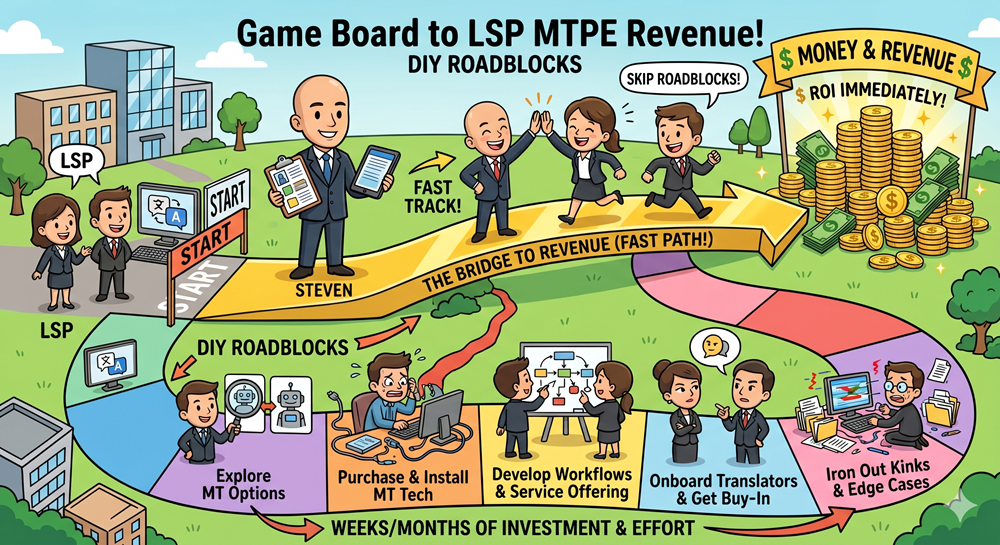
Building a robust internal MT system from scratch—not just shoving documents through Google Translate or DeepL—means dedicating weeks or months to researching engines, purchasing complex tech, designing workflows, fighting for translator buy-in, and suffering through live project kinks. And that’s not even mentioning the hurdle of actually selling it to your clients. It is a massive investment of time and capital before you earn a single dollar.

You don’t have to build the infrastructure first and then start capturing the revenue later. 

My premium, turnkey MT service (GAIT-Augmented MT & MTPE) for boutique LSPs acts as your immediate fast track. Because I have already spent years engineering, testing, and optimizing the technology stack and workflows, you get to skip the long, winding road of DIY roadblocks entirely. All you have to do is put the service in front of your clients, start selling, and generate profit today.

Complete Flexibility and No Lock-In

If you are worried about long-term dependency, you can rest easy. This partnership is designed to launch your service, not lock you in.

  • Plug-and-play setup: My service requires absolutely no changes to your current infrastructure or processes. I give you the ultimate flexibility to redirect your strategy later, keeping in mind that those rigid, automated systems will never play this nicely.

  • Scale from a position of strength: Once your volume grows and you are already generating revenue, you can start looking for your own automated systems using my premium output as your baseline quality benchmark.

  • Full data ownership: With my service, you retain full possession of your language resources (TMs, glossaries, style guides) every step of the way, ensuring a seamless transition whenever you are ready to bring the process in-house (if you think you can do better!).

  • A permanent safety net: Even if you decide to scale your internal infrastructure, I remain on call to handle highly complex edge cases, projects with strict quality specifications that automated systems simply cannot match, absorb sudden overflow volume, or step in if your own technology goes down.

Who my GAIT-Augmented MT & MTPE service is for:

  • Boutique LSPs wanting to sell premium MT/MTPE using current linguists, without buying, learning, and using new tech
  • Boutique LSPs seeking to test and scale their MT market with premium quality from day one
  • Boutique LSPs struggling to win MTPE buy-in from their best human translators
  • Boutique LSPs needing an agile backup for complex edge cases and higher quality demands
  • Boutique LSPs doubling down on human expertise and collaboration to outcompete full automation

⇒ Ready to get find out more? Email me at sbammel@cotranslatorai.com to discuss.

Advanced AI Built with Human Expertise

Technology is only half the battle. Your veteran linguists remain your most valuable asset, which is why supporting them through this transition is built directly into my baseline service.

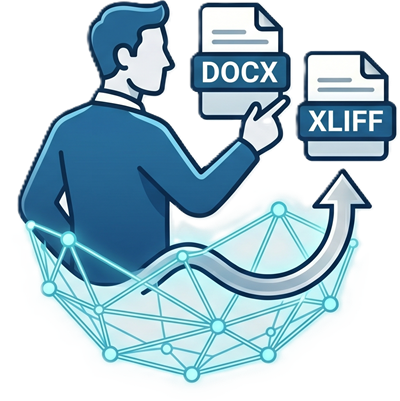
  • File formats: I handle the complex backend prep (like defragmenting subtitles or fixing tags) so translators receive clean, ready-to-work Word or .xliff files.

  • Minimal “janitorial” work: Cohesive, context-aware drafts let your linguists apply their actual expertise, rather than wasting time fixing robotic sentence structures.

  • Translator coaching & guidance: I provide direct support to help veteran translators overcome the ‘perfectionist mental block,’ teaching them to optimize for speed without burning out.

  • Collaborative LLM training (optional): Translators can provide an initial sample to fine-tune the AI output, aligning the machine’s output with the translator’s own style for the rest of the project.

  • Favorable economics: With high-quality drafts and the right coaching, translator throughput skyrockets and quality edges up. This allows your best translators to stay competitive and properly compensated.
Powered by Generative AI Iterative Translation (GAIT)

GAIT-Enhanced MT & MTPE delivers fundamentally superior results compared to automated, segment-by-segment engines.
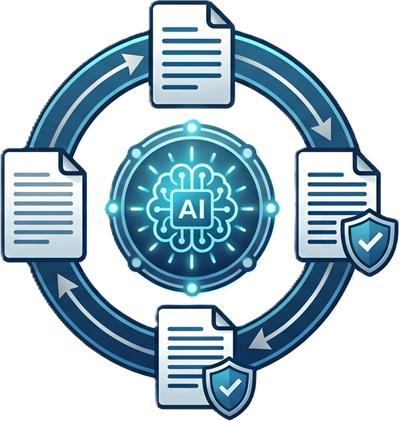
  • Context-aware: Reads entire sections rather than isolated segments to understand intent, ensuring a natural flow and stylistic consistency from the first page to the last.

  • Terminology integration: Glossaries are injected before generation, guaranteeing your key lexical terms are applied to the machine’s output.

  • CAT-tool compatible: Delivered in standard formats (.xliff, .docx, .tmx) that fit seamlessly into your existing tech stack with zero learning curve.

  • Formatting preserved: Native tags and layouts remain intact, reducing pre- and post-translation prep time.

  • Highly secure: Enterprise-grade encrypted API guarantees client data remains strictly confidential and is never used to train public models.

  • Flexible scale: Effortlessly handles everything from small, one-time requests to large and high-frequency projects, including those with tight deadlines.

Thank you for your quick help this weekend. Our linguist was happy with the quality of the Chinese>English machine translation and was able to post-edit it quite quickly.

Emma Fields, Project Manager, TransLingua

How It Works

Intentionally engineered; not instantly generated.
Step 1: Project Initiation

Send your source files, TMs, and instructions exactly as you would for a regular human translation process. You can send them via email or secure download, or I can pull them directly from your online TMS. Zero adjustments to your current workflow are required.

Step 2: MT Processing

I import the files into my memoQ environment, apply your reference content, and run the text through the context-rich Generative AI Iterative Translation (GAIT) workflow.

Step 3: Translator Post-Editing

I provide clean, machine-translated files in virtually any format—including bilingual Word, fully tagged .xliff, and final target formats—or I can upload them straight to your online TMS. It’s entirely up to you. This gives translators the freedom to work wherever they are most comfortable and efficient—whether inside their favorite CAT tool, directly in your TMS, or completely outside of a translation environment—without compromising your project requirements.

Step 4: Post-Edit Processing

The post-edited files are returned to me. I process them back through memoQ, utilizing a mostly automated sequence to reintegrate the post-edited translations.

Step 5: Final Delivery

I deliver the translated files to you in the same format as the source, along with the updated project TMs. You are now ready for your standard internal QA or direct delivery to your client.

Steven handled a 175-page cross-border legal translation from Korean into English for us this year, delivering excellent work on time as he has done for us for many years. Prior to starting the project, he explained that, with our consent, he could use the GAIT Workflow, an AI-assisted translation process designed to help professional human translators work more efficiently while maintaining quality. As a reviewer of legal translations for nearly 20 years, I could see that his approach provided quality work in a quicker timescale than expected, but also required human knowledge, experience and input in order to achieve such a good result. Linguistico will certainly continue exploring this workflow as it provides an excellent end product for translators, LSPs and clients in the legal sector where “good enough” is simply not good enough.

David Salter, Director, Linguistico

A True Plug-and-Play Workflow

Zero ramp-up time. Ready to implement this afternoon.

OPERATIONAL BURDEN YOUR COMMITMENT
Financial & Commercial
  • Upfront capital investment
NONE
  • Fixed monthly overhead
NONE
  • Term contracts & commitment
NONE
Technical Infrastructure
  • System setup & integration
NONE
  • IT infrastructure maintenance
NONE
Daily Operations
  • Additional execution steps
NONE
  • Existing process restructuring
NONE
  • Language resource upkeep
NONE
Team & Training
  • Staff learning curve
NONE
  • Translator training
NONE

Pricing & Economics

A variable-cost structure designed to protect and widen your margins.

GAIT-Augmented MT

USD $0.01/English word (or equivalent)

Included in the base rate:

  • Formatting preservation: Native tags, styles, and document layouts remain completely intact

  • Style & glossary injection: Basic translation memory (TM) and termbase (TB) integration to ensure your preferred terminology is applied from segment one

  • Zero API or token fees: I run this pipeline exclusively on top-tier frontier LLM models (not downgraded “efficient” versions) and absorb all enterprise data costs entirely.

NOTE: The baseline service is a pure, clean-text AI workflow within a single file format from the source language to the target language. It does not include file format conversions, desktop publishing, OCR cleanup, or heavy manual file prep. See the premium add-ons below for enhanced workflow services.

GAIT-Augmented MTPE

USD $0.015/English word (or equivalent)

Includes everything in GAIT-Augmented MT + the following:

  • Translator onboarding resources: Access to transition coaching and training materials to help your linguists adapt to AI-assisted editing—available only if and when you want me to engage with your team

  • Follow-the-sun overnight turnarounds: Because I am located in Korea, I process each step of the workflow while your US/EU teams sleep, delivering them to your inbox by your next business morning.

Getting Started

  1. Alignment Call: A quick Zoom chat to map out exactly how my pipeline can plug directly into your specific TMS and daily PM routine with zero disruption.

  2. Free Capability Check: Send me a sample of your most complex formats (InDesign, SRTs, etc.) and I will provide a transparent breakdown of exactly how they will process.

  3. Complimentary Test: Send a zero-risk initial test project (approx. 10,000 words). I will process it entirely on the house so your team can evaluate the quality and workflow firsthand.

⇒ Ready to get started? Email me at sbammel@cotranslatorai.com to lock in your slot.

Discount factors:

  • High-volume scale: Reduced per-word rates for large-scale document batches or high-capacity monthly pipelines

  • Concurrent multi-language processing: Cost efficiencies when translating a single English source file into multiple target languages simultaneously

  • Repetition and TM matches: CAT discounts applied even to internal text repetitions and out-of-scope translation memory matches

Premium add-ons:

  • Performance-based volume reduction: By meticulously preparing and cleaning your files upfront, I extract hidden internal fuzzies and repetitive segments from the post-editing pool entirely. This improves turnarounds, ensures internal consistency, and drastically shrinks your human linguist costs. I bill a fractional performance fee exclusively on the exact word count I eliminate—meaning I am only rewarded when I actively save you money.
  • Complex file engineering: Pre-processing for PDFs, OCR-converted Word files, video captions (SRTs) with timestamps, files with tracked changes/unusual segmenting, and other high-touch file management
  • Full-service management: End-to-end project management, additional automated QA passes, or collaborative translator workflow upgrades
  • Rush delivery: Unusually expedited turnarounds

More Hidden Value in the Pipeline

Unexpected operational and financial wins built right into the service
  • Lower post-editing costs: By meticulously preparing and cleaning your files upfront, I remove unnecessary or repetitive segments from the post-editing pool entirely, saving you money from day one. This also improves turnarounds and promotes internal consistency.

  • Advanced CAT-tool support included: Even with the baseline service, you aren’t just getting raw text—you get full, advanced CAT tool processing and technical preparation included. (Full project management options are also available as a separate add-on).

  • Double down on savings: Enjoy even greater cost efficiencies by bundling this technical pipeline with my signature, turnkey English <> Korean language services, as needed.

You Have the Backend. Now, How Do You Sell It?

Here is how to package it to start growing your business again.
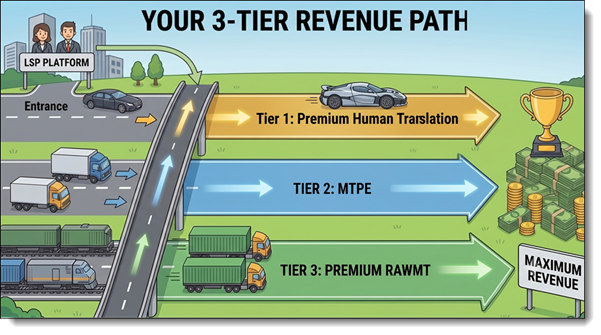
The tech is covered, but the big question remains: How do you offer lower-cost AI and MT without cannibalizing your premium human revenue?

You do it by evolving from a vendor into a comprehensive language consultant.

My customizable blueprint shows you exactly how to package your backend into a multi-lane content highway—allowing you to capture every budget, protect your margins, and become your clients’ sole-source partner.


Explore the 3-Tier Service Model Blueprint ➔

Got Questions? Let’s Clear the Board

If there is anything I haven’t covered below, just drop me an email—I’ll be glad to walk you through it.

What exactly makes your GAIT-Augmented MT premium?2026-06-07T06:12:55+00:00

Conventional machine translation is an automated, static process that produces disconnected text, turning premium translators into mechanics forced to clean up a machine’s mess. While better engine customization is possible, boutique LSPs rarely have the dedicated backend engineering staff required to pull it off.

My approach bridges this gap. I use a highly curated, iterative workflow that removes the mechanical friction entirely and delivers contextually fluent drafts right out of the gate. The result is a fundamentally higher-quality baseline that reads naturally and is significantly easier—and much less frustrating—to post-edit.

The biggest differentiator is how I eliminate the “Frankenstein Effect.” Conventional MT translates segment-by-segment with little-to-no context, independently mixing exact TM matches, fuzzy matches, and raw MT. This forces the translator to stitch a disjointed text together. I translate in broad, context-aware blocks across as few context windows as possible. By feeding TM hits and a “gold standard” sample—even the translator’s own work, if possible—directly into an anchor prompt that holds the project together even when changing context windows, the entire document is generated in a cohesive, fluent voice.

Next, I solve the formatting and tag issues that plague cheap MT. Where automated systems break segments, lose formatting, and create frustrating “tag soup,” I take the time to manually prepare the source text. I correct segmenting, strip unnecessary tags, lock out high-value internal fuzzies, and maintain formatting before the translator ever touches the file.

Furthermore, my process is dynamic and iterative, whereas standard MT is completely static. As a large project progresses, I actively tweak and improve the AI prompt based on ongoing feedback to eliminate structural problems and capture new terminology as we go.

Ultimately, this elevates the translator experience. Instead of acting as a “janitor” fixing mechanical glitches, your linguist is empowered to act as a strategic editor. Because the MT is tailored to their style and stripped of irritating mechanical roadblocks, their cognitive load drops. They gain a sense of ownership over the iterative process, allowing them to work faster, happier, and focus on higher-level quality.

You get a smoother workflow, your translators get a better working experience, and the end client receives a superior final product.

Can you project-manage the work from beginning to end?2026-06-11T09:15:58+00:00

Absolutely. Through the On-Call MT Department service, I am already managing the most complex pieces of the puzzle: outsourced MT and MTPE pipelines, advanced CAT tool integration, and direct, hands-on coaching with your linguists.

Because that technical heavy lifting is already built into the core service, wrapping it into a full, end-to-end project management workflow is a natural and seamless extension. If you want the entire process handled—from initial source file handoff to final delivery—I can take the entire weight of the project off your shoulders.

How can I be sure my post-editors will do a good job?2026-06-11T09:36:30+00:00

The best way to ensure quality is to refuse to replace your trusted, career translators with cheap, inexperienced post-editors. Many veteran linguists are actively resistant to MTPE, but you can hardly blame them. Most have been burned by horror stories of sloppy, unmanaged workflows created by buyers who use AI solely as an excuse to slash rates, leaving the translator to clean up an unusable mess.

When you instead provide these career professionals with a strong, GAIT-augmented baseline and guide them through the realization that “fit for purpose” doesn’t mean bad translation, everything changes. Their cognitive burden drops. Instead of fighting the machine to create a bespoke masterpiece, they are able to apply their deep expertise efficiently, meeting your client’s requirements with far less friction.

Crucially, this approach also proves to your translators that you are invested in their longevity. While mega-agencies are busy trying to engineer humans out of the process entirely, this workflow demonstrates that their expertise is still the anchor of premium translation. By guiding them through this method, you are showing them the best possible way to profitably ride the wave of AI-driven volume—securing their place in the future of premium mid-market translation.

Ultimately, if you work with professionals who have built their livelihoods—and their decades-long relationships with you—on delivering excellence, you already have the ideal setup. When you arm those proven experts with a genuinely supportive MT workflow, you get a level of reliability and loyalty that cut-rate newcomers can never match.

If this workflow is so much better than the conventional approaches, why isn’t the rest of the industry doing it?2026-06-11T09:09:03+00:00

The short answer is that the language services industry is currently split into two camps, and neither of them is focusing on the premium middle. Mega-agencies are obsessed with rigid, high-volume automation, and boutique LSPs are struggling to adapt to the tech. Even when boutique LSPs do adopt the technology, they buy off-the-shelf tools from the big guys and try to run them the exact same way.

I am able to offer my On-Call MT Department because I bridge four gaps that nobody else is touching:

  • Tech-linguist divide: The industry is deeply siloed. You have software engineers building MT pipelines who have never translated a complex document, and you have veteran translators who despise automation. Designing the GAIT workflow took a career translator (me!), and executing it requires someone who fluently speaks both “systems engineer” and “strategic linguist.”

  • Avoidance of complex, bespoke workflows: Large platforms rely on off-the-shelf engines to maintain their margins. They are not going to have a human establish a “gold standard” translation, manually carry translations outside the CAT tool to maintain context, and dynamically iterate the process back into the AI to align the rest of the document—especially on low word counts. That level of involvement takes a human language professional.

  • Unwillingness to address the human bottleneck: Tech companies want to sell you software licenses; they don’t want to solve human resistance. Translators are facing a difficult paradigm shift right now. No software vendor or mega-agency is going to do the unbilled, behind-the-scenes work of directly coaching career linguists to adopt a post-editing mindset. They’ll just dumb down their workflows and hire someone else to fill in instead. My workflow, on the other hand, is designed specifically to encourage you to onboard your own trusted linguists, many of whom you’ve worked with for decades. This keeps human expertise in the industry, and specifically, focused on your work so together, we can deliver premium MTPE.

  • File-prep blindspot: It’s not really a blindspot. Everybody knows it’s a problem; they just don’t want to be the one to solve it because it requires hard work. So standard MT providers just plug text into an engine, completely ignoring the mechanical friction—the OCR errors, broken formatting, fragmented segmentation, and “tag soup”. They then push the task of fixing all that off to the post-editing step at cut-rate prices, pretending that this won’t affect client-delivered quality.

The reason I am the only one offering this service is that I am not just selling you software access. I am managing the entire messy intersection of file preparation, dynamic AI prompting and translation, and human linguist collaboration, while seamlessly integrating with your existing systems—so you can stay focused on your core business without getting stuck in the technological weeds.

Ultimately, my hope is that this does become the standard in the premium middle of the translation industry. In fact, I am ready to teach others how to do this, too.

Briefly, how does the outsourced MT workflow work?2026-06-01T10:35:24+00:00

Project handoff is exactly like a regular translation assignment. You send me the source files, and I return context-aware, AI-generated drafts fully optimized for your human linguists to post-edit. Once your translators are done, I handle the technical back-end processing to deliver clean, final translated files.

In other words, this workflow is designed to enhance your existing process, not replace it. The goal is simply to provide fundamentally better raw AI output than standard segment-by-segment machine translation, while preserving seamless compatibility with your CAT tools, translation memories, and QA workflows.

Which AI or machine translation engine do you use?2026-06-01T10:46:58+00:00

My primary workflow is built on frontier large language models (LLM) accessed via enterprise APIs (primarily OpenAI). This is completely distinct from the public ChatGPT interface or consumer subscription plans. The enterprise API enforces strict data privacy; your content is fully encrypted and never used for model training.

I also do not simply run files through standard MT engines like DeepL or Google Translate. The core value of my service is in the engineering: combining advanced LLMs with technical CAT-tool pre-processing, translation memories, terminology injection, and project-specific prompting. This optimizes the draft before it ever hits a human editor. If your security compliance or project requirements dictate a different LLM (like Anthropic Claude, Google Gemini, or a European-hosted option like Mistral), I can adapt the pipeline to support that, too.

What languages can you handle?2026-06-01T10:49:31+00:00

I can support virtually any language pair because large language models are inherently language-agnostic. However, output quality naturally scales with the volume of training data available for a given language.

You can expect exceptional, human-like drafting for all high-resource language pairs, including major Western languages, East Asian languages, and dominant regional markets. For lower-resource or less common languages, the baseline can vary. In those cases, I am always happy to run a complimentary test project so your team can evaluate the output quality before committing.

Can you use our translation memories and term bases?2026-06-01T10:56:57+00:00

Yes. If you have translation memories (TMs), term bases (TBs), glossaries, or style guides, I can integrate them directly into the generation pipeline.

While it is neither efficient nor necessary to dump a massive, multi-megabyte TM into an active AI prompt, my workflow utilizes a targeted injection process. I extract and feed only the most relevant segment matches, contextual terminology, and structural examples directly into the engine for that specific project. This keeps the AI hyper-focused, ensuring the raw draft strictly adheres to your client’s established tone, style, and approved vocabulary from line one.

What if we do not have a clean TM or term base?2026-06-01T11:02:22+00:00

That is not a problem at all. The workflow can start completely from scratch. If you don’t have existing translation assets, we can easily bootstrap the process using two highly effective methods.

First, we can use the “gold standard” sample approach, where your native linguist translates a small, initial section of the project. I then use that approved human sample to fine-tune the prompt, aligning the AI’s style, tone, and terminology choices with your translator’s preferences for the remaining files. Alternatively, we can use an iterative feedback loop for multi-file or rolling projects, where the workflow learns as it goes. Once your translators post-edit the first batch of files, we feed those corrections back into the prompt to improve the quality of the next delivery. Furthermore, for smaller projects without rigid pre-defined specifications, we can simply let the frontier model run without heavy customization and still deliver an excellent, internally consistent draft that is immediately ready for post-editing.

In other words, you don’t need legacy data to get started. This is a highly adaptable pipeline designed to build your linguistic assets from day one, rather than requiring you to bring them to the table.

Can you work with legal, medical, healthcare, or technical content?2026-06-01T11:07:28+00:00

Yes. In fact, frontier LLMs perform exceptionally well with highly specialized domains, especially when paired with clear glossaries, translation memories, or reference materials.

Technical, medical, and healthcare content often yields incredibly strong baseline drafts—even without extensive reference assets—because the models possess a vast inherent knowledge base of scientific nomenclature and engineering concepts. Legal content also benefits significantly from this workflow, though it requires a human eye with particular care. Because legal texts rely on long, complex sentence structures and precise logical relationships, these segments must be reviewed carefully by qualified legal translators.

In all high-stakes domains, the AI draft is designed to drastically reduce cognitive fatigue and enforce terminology consistency, but it never replaces the absolute necessity for expert human post-editing and rigorous subject-matter QA.

How do you handle translator resistance to AI or MTPE?2026-06-01T11:16:24+00:00

Linguist buy-in is the single greatest hurdle in any AI-assisted workflow. My approach is to neutralize this resistance by removing the standard friction points: providing genuinely superior draft quality, giving them active input into the process, and ensuring complete file flexibility within their preferred tools. When translators realize the AI draft is a helpful tool rather than a hindrance, engagement changes completely.

That said, many veteran translators still resist MTPE, often arguing that editing takes longer than translating from scratch. While that is true for deficient, traditional MT, with premium generative AI the real barrier is often psychological—the “perfectionist mental block.” Success requires shifting their mindset from artisan translation to strategic editing. When linguists realize the client is paying for accurate, fluid, and well-composed text that meets exact project specifications—rather than an idealized, hyper-stylized version of perfection—they can learn to watch the clock, lean on the engine, and scale their throughput dramatically.

The economic fear is equally real: translators see lower per-word rates and assume they are being asked to do the same amount of heavy lifting for less pay. The breakthrough happens when they see that drastically higher productivity unlocks massive volumes of content that previously lacked the budget for human translation entirely.

Because alignment is so critical to your margins, I have developed specialized translator training materials and offer ongoing linguist coaching at no additional charge. Over time, we don’t just optimize your pipeline; we help transition your trusted human network into a highly compensated, future-proof workforce.

Can translators choose how they post-edit the files?2026-06-01T11:18:06+00:00

Yes, absolutely. Flexibility is key to reducing linguist friction, so I can deliver post-editing files in whichever format best fits your agency’s pipeline and your translators’ preferences.

Standard delivery options include fully compatible XLIFF files for import into any major CAT tool (like Trados, memoQ, or Phrase), standard bilingual Word tables for offline editing, or final formatted documents for direct, on-page refinement. The goal is to make the asset integration entirely invisible to the post-editor, allowing them to work in their comfort zone while fully preserving your existing project workflow.

Can you work inside our existing CAT-tool or TMS workflow?2026-06-01T11:25:21+00:00

Yes. My process is designed to adapt to whatever level of integration your agency prefers.

If your team works locally, your project managers can simply send over standard files or .xliff exports from their CAT tools. However, if your workflow relies on a centralized, server-based TMS, I can log directly into your system to extract the files, run them through my backend AI engineering pipeline (including the post-editing steps), and upload the post-edited files back into your platform myself.

Whichever route you choose, your internal project structure, vendor assignments, and client-facing workflows remain completely unaffected, and under your control. You get all the power of an advanced generative AI pipeline with absolutely zero extra administrative burden on your production team.

Do you work directly with our translators?2026-06-01T11:27:17+00:00

This is entirely up to your agency’s operational preference. I can work strictly through your project managers or communicate directly with your translators during the post-editing stage if that makes the workflow smoother for your team.

Some agencies prefer to keep all file routing and communication centralized internally. Others find that letting me interact directly with their post-editors helps resolve technical questions faster, provides immediate coaching support, and eliminates production bottlenecks. I am completely comfortable with either approach and will strictly adhere to your agency’s communication protocols.

Do we have to send every project through you?2026-06-01T23:19:42+00:00

Of course not. This is a fully outsourced, on-demand service. You can use it strictly when it makes strategic sense for your business and stop at any time—there are no monthly retainers or volume commitments.

For example, you might leverage my pipeline for large-scale projects with tight turnaround times, for enterprise clients explicitly requesting a lower-cost AI or MTPE option, or for high-volume workloads where a superior AI draft would drastically cut down your human linguists’ editing hours. You retain total operational freedom, utilizing this service exactly the same way you manage your standard roster of freelance translators (i.e. “on call”).

Do we own the final translation memory after the project?2026-06-01T11:33:03+00:00

Yes. Just like with every traditional project you outsource to freelance linguists, complete ownership of the linguistic output belongs entirely to you—or your end client, depending on your internal arrangements.

At the wrap-up of each project, I deliver the final updated bilingual files and the corresponding translation memory data back to you. You never lose ownership or control of your linguistic assets. Every TM, term base, and finalized bilingual segment remains your intellectual property, fully formatted and ready for your future use.

Is this a licensed tool or a service?2026-06-01T11:37:03+00:00

This is strictly an outsourced service, not a software license, protected algorithm, or a subscription platform you have to manage.

You don’t need to purchase any tools, manage cloud infrastructure, or train your team on new systems. You simply send me your project files, I process them using my advanced AI engineering workflow, and I handle the execution from start to finish. You use it completely on-demand—whether that means one time, occasionally, or as a regular extension of your team. You are paying for delivered results, not a software seat.

Is the process secure?2026-06-01T11:39:21+00:00

Yes, absolutely. The entire pipeline is built for professional translation projects where confidentiality and strict data protection are non-negotiable.

My primary workflow utilizes frontier large language models accessed exclusively via enterprise APIs. This is completely distinct from the public ChatGPT interface or consumer subscription plans. The enterprise API enforces corporate-grade data privacy: your content is fully encrypted in transit and at rest, and it is legally barred from being used for model training.

Furthermore, if your specific compliance rules or end-client NDA requirements dictate a different infrastructure—such as Anthropic Claude, Google Gemini, or a European-hosted option like Mistral—I can adapt the pipeline to match that security protocol, too.

Can we test the workflow before using it on a live project, and how should we evaluate it?2026-06-01T23:20:11+00:00

Yes, please do. A test project is the ideal way to evaluate the pipeline before deploying it on a live client assignment. A standard test typically consists of an internal sample or a selected batch of approximately 10,000 words in a language pair where you have trusted, in-house reviewers.

To get an accurate baseline, I recommend running a direct side-by-side comparison against your current MT or AI setup. Have your linguists evaluate the results based on both linguistic quality—such as fluency, context handling, stylistic consistency, and adherence to terminology—and production efficiency, which measures the actual post-editing effort required, time saved, and how seamlessly the files integrate back into your pipeline, as well as cost and workflow burden on your end. This structured comparison will give you objective data on exactly how much this workflow improves your margins and translation speed compared to standard market alternatives.

Can you process new words only, or can you also work with fuzzy matches?2026-06-01T11:43:37+00:00

Yes, I can handle both. If you want to isolate my workflow to no-match or new segments only, we can easily lock or exclude your existing fuzzy matches so they remain completely untouched. Alternatively, if you want the pipeline to process fuzzy matches alongside new text, I can feed the existing translation memory strings directly into the prompt as context. This allows the AI to reference your legacy data while generating the updated translation. We can align on your specific leveraging preferences before the project kicks off to ensure the output matches your exact expectations.

Can you translate PDF files with your workflow?2026-06-05T11:28:06+00:00

Yes, but it requires additional steps, time, and cost.

The AI pipeline thrives on clean, editable, well-formatted text. Converting source files from one format to another falls outside the scope of the basic service. Because there is currently no automated method to translate a PDF without compromising output quality (this applies to both direct CAT-tool functionality and the more common practice of saving a PDF to a Word file), additional work is required at the preparation stage, during the MT processing inside the CAT tool, during post-edited translation processing inside the CAT tool, and at the final review stage. Depending on the condition of the original PDF files, the processing of these PDF files can still be viable for a high-quality MT workflow, or they may not.

For this reason, you should always push your client hard to provide native, non-PDF source files. Remind them that doing so will save them significant amounts of money, deliver a better final product, and reduce turnaround times.

However, if native files are impossible to get and we are stuck with PDFs, here is how the workflow goes.

1. Before starting (your responsibility)

You convert the PDFs to Word before sending them to me. Simply saving to Word will result in formatting anomalies proportional to the complexity of the source. Even under ideal circumstances, this raw Word file will be riddled with strange formatting, broken segmentation, and unnecessary inline tags. If the PDF was a scanned document, it will also have OCR errors. These issues ruin CAT tool leverage, leading to higher post-editing word counts and internal inconsistencies.

The more you clean up this Word file in advance, the less you will pay for MT processing and post-editing later. This is especially critical for multi-language projects, where unfixed source problems multiply across every target language. Because preparing Word files from PDFs is not included in my services, you must arrange for a file conversion or DTP service to process the PDFs into the cleanest Word files you can get before handing them off to me.

2. Preparing the MT (my responsibility)

No matter how good your conversion service is, the files I receive will still have segmentation and tag problems. I run an automated process to strip most excess tags, then go through the document segment-by-segment to manually split and join broken segments so the post-editor receives clean, readable text. Sometimes this involves the time-consuming task of joining non-contiguous segments (which then have to be re-separated out after post-editing).

I do not fix OCR errors in the source. Fortunately, the AI is surprisingly good at translating straight through light OCR mistakes by using surrounding context. But PDF formatting and OCR errors introduce random variations that hide duplicate segments and high-value fuzzy matches from standard CAT tool analysis. I use specialized techniques to hunt these down, lock them out, and ensure they are only translated once. This can drastically reduce your billable post-editing word count. Because this TM prep is highly time-consuming but generates significant financial savings for you, I split the difference by charging a separate fee for a portion of the savings generated by this effort.

Also, as a final hurdle that PDFs files place in front of us, the process of pre-processing all these PDF files results in the source files invariably being provided on a rolling basis, rather than all at once at the beginning. This also creates a small additional burden on the workflow, especially the process of locking out hidden duplicates and internal fuzzy matches.

3. Post-processing (my responsibility)

Once the translator returns the post-edited files, I save everything to the TM. I run an automated pre-translation for the standard duplicates, and manually pre-translate the hidden duplicates and fuzzy matches I isolated earlier. Finally, I export the text back to a Word file and manually correct any remaining non-contiguous segment breaks.

I do not do any further manual formatting. This is the file I deliver back to you.

4. The final polish (your responsibility)

This final file requires one last pass by your DTP or conversion service, and potentially a final QA by your post-editors. Because all non-translatable text (like numbers, codes, and terms that remain in the source language) is locked out during post-editing, any original OCR errors hidden within those numbers will remain in the output. Your team must compare these against the source PDF and fix the final layout before delivering to the end client. At this point, you can then deliver Word files, or save back to PDF and deliver those.

The bottom line

The four major PDF hurdles—formatting, segmenting, tags, and OCR—multiply the workload. It slows me down significantly, and you will also need DTP support at both the beginning and the end. Depending on the condition of the original PDF, my costs will generally be 2 to 3 times higher than the base rate for MT-processing a native source file. However, thanks to my deep TM preparation, your actual post-editing costs will likely drop lower than the initial CAT-tool analysis suggests, giving you a possible windfall to partially offset the extra work.

Because every PDF is a unique challenge, let’s pow-wow at the start of the project to map out the most efficient and cost-effective strategy.

Can you work with subtitles and SRT files?2026-06-01T23:24:13+00:00

Yes, and I have a highly efficient system for it. I utilize a dedicated workflow and automated tools specifically engineered for multimedia formats like SRT files.

The pipeline automatically isolates the translatable text while locking the underlying timecodes, ensuring the content is processed smoothly and can be seamlessly converted back into a properly synced caption format without corruption. Crucially, my workflow reconstructs and presents clean, natural sentences for your translators to work on, rather than the chopped-up, fragmented captions that typically slow them down and degrade quality. Once the editing is complete, the system automatically stitches everything back together and delivers a clean translation memory output at the end. It eliminates the traditional operational bottlenecks of subtitle localization with absolutely no downside to your production pipeline.

Can we still run our own QA after your step?2026-06-01T23:24:54+00:00

Yes. In fact, I highly encourage it. My workflow is designed to enhance your existing quality gates, not replace them.

Because the finalized files are delivered back to you in standard native formats like XLIFF, your project managers can import them right back into your CAT tool or TMS and run all your normal automated QA checks—such as verifying terminology adherence, number formatting, tag placement, and internal consistency—before final sign-off. At the end of the day, this is a standard, professional translation workflow. It gives you all the efficiency of advanced AI while leaving the ultimate quality control exactly where it belongs: in your hands.

Can you provide your own post-editors and handle the entire process end-to-end?2026-06-01T11:57:16+00:00

No, and that is by design. I do not provide multilingual post-editing, nor do I compete as an LSP.

This is a specialized AI engineering service built specifically to help you leverage and scale the trusted freelance network you have spent years building. My goal is to optimize the technical pipeline and deliver a vastly superior draft on the backend, leaving the final human polish entirely in the hands of your team. You retain absolute control over your linguist relationships, your margins, and your final quality.

When should I use this service, and when should I stick to traditional workflows?2026-06-01T12:04:05+00:00

This workflow is especially well-matched for projects where quality matters but the client also demands faster turnarounds, lower costs, or highly scalable production. It is a perfect fit for high-volume workloads, recurring account work, content backed by rich translation memories or glossaries, and any situation where standard raw machine translation simply isn’t good enough. The best candidates for maximum ROI are technical, administrative, or standard corporate materials where terminology consistency and velocity are your top priorities.

Conversely, highly creative marketing copy (transcreation), high-stakes literary work, high-budget high-nuance translation, and other workflows where the translator really is expected to deliver their version of perfect every time are not ideal candidates for a standalone AI draft. Similarly, projects requiring rigid, exact adherence to legacy fuzzy-match phrasing are more complex and require extra planning. While my pipeline can still provide a powerful, efficient starting point for many of these creative or restrictive scenarios, they naturally demand a much heavier human-in-the-loop editing process.

Go to Top