The Three-Tier Service Model for LSPs

The Three-Tier Service Model for LSPs2026-06-11T08:19:21+00:00

A new way to compete against automated free and cheap

Clients are relentlessly demanding MTPE—or simply using free machine translation—to fit shrinking budgets. If you only offer premium, full-human translation, you are leaving huge amounts of high-volume content on the table because clients simply won’t allocate the budget for it.

Worse, when you turn down these low-stakes projects, you lose your premium work, too. Your narrow service offering forces your clients to seek out tech giants, mega-agencies, or ChatGPT—all of whom are happy to automate you out of the relationship entirely. To survive and thrive, independent LSPs must evolve from traditional word vendors into comprehensive language consultants. That is where the Three-Tier Service Model comes in.

Distributing your clients’ work across three distinct quality tiers gives them the budget flexibility they crave while actively protecting—and even widening—your own margins. This framework isn’t about slashing your prices or cutting corners; it is a strategic blueprint that allows you to:

  • Turn budget constraints into a sales tool: Capture higher overall volumes by finally monetizing high-volume, low-stakes content streams.

  • Protect your human talent: Guard your best linguists’ time so they can focus entirely on premium work.

  • Become the ultimate gatekeeper: Secure a predictable flow of recurring revenue and position your agency as an indispensable, sole-source language partner.

Refer to the framework below as a customizable baseline to fit your agency’s specific economics and sales strategy.

Monetize Every Client Budget

Become your client’s sole language partner and protect your territory from cheap tech alternatives.
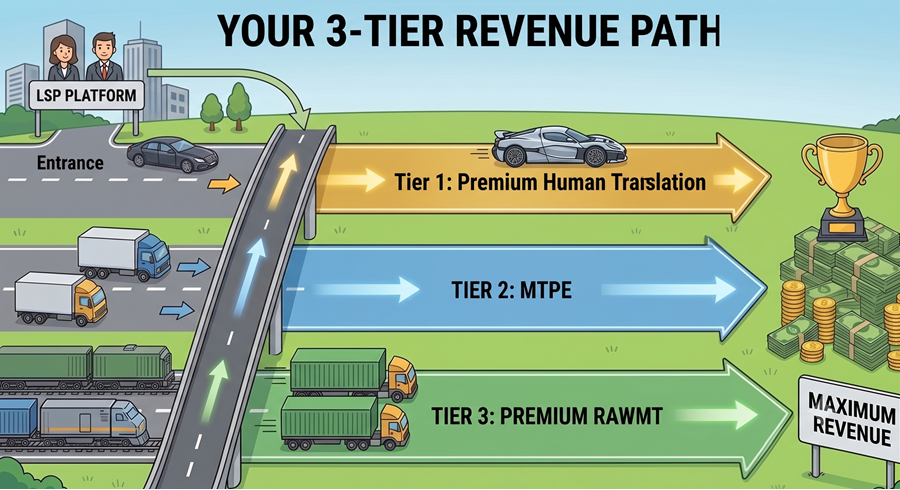
Think of your clients’ multilingual needs like traffic. Instead of forcing every piece of content to travel the same expensive, slow-moving road, you can segment their projects into a multi-lane highway designed for maximum efficiency and maximum revenue:

  • Tier 1: Premium Human Translation (The VIP Lane): Like a high-performance sports car, this lane is reserved for brand-critical, highly creative, or legally sensitive cargo. It demands premium craftsmanship from your best human linguists and commands your highest margins.

  • Tier 2: MTPE (The Standard Commute): Like a reliable delivery truck, this is the perfect middle ground for everyday corporate documentation. It offers faster turnarounds and lower costs through machine translation, finalized by human post-editing to ensure perfect cohesion.

  • Tier 3: Premium Raw MT (The High-Volume Freight): Like a massive freight train, this lane is built purely for scale. It moves massive data dumps and internal reports at lightning speed and ultra-low cost, capturing volume you would otherwise lose entirely.

Refer to the framework below as a customizable baseline to fit your agency’s specific economics and sales strategy.

The Three-Tier Service Blueprint

Refer to this suggested modern, flexible pricing framework.

Tier 1: Full Human Translation Tier 2: Machine Translation Post-Editing (MTPE) Tier 3: Premium Raw MT
Client Pricing: 100% (your standard rate) Client Pricing: ~50% (of your standard rate) Client Pricing: 10–15% (of your standard rate)
Client Value: 80% of Tier 1 Client Value: 50% of Tier 1
(same margin as your Tier 1 service) (higher margin than your Tiers 1 and 2 services)
Premium, from-scratch translation for brand-critical, highly creative, or legally sensitive texts. The perfect middle ground. Faster turnarounds and lower costs without sacrificing cohesion. Highly readable, formatted, glossary-accurate drafts for internal use on huge volumes.
Handled entirely by your trusted linguists (business as usual). I supply a context-aware, fully formatted draft. Your linguists refine it. I process the native files end-to-end. Zero linguist intervention required.

How to Pitch Tier 3

When a client relies on free tools, they are bleeding money through hidden operational costs. 

The Eleven Hidden Costs of “Free” MT Your “Cheaper-than-Free” Pitch to the Client
1. – The Cost of Data Insecurity: Free and paid chatbots feed your client’s confidential corporate data and IP straight into public training models. “Keep your secrets secret.”
2. The Cost of Unstructured Content: Native formatting is destroyed, resulting in broken layouts that require hours of manual fixing. “Bolster your professional image.”
3. The Cost of Segment-Locked MT: Standard DIY tools translate sentence-by-sentence, missing the document-level context needed for true accuracy. “Give your readers compelling content.”
4. The Cost of Data Limits: Free tools throttle volume. Massive data dumps choke the system, eventually forcing expensive enterprise licenses anyway. “Scale without hitting walls.”
5. The Cost of Time: Internal staff waste hours copying, pasting, and fumbling with tech instead of doing the jobs they were hired for. “Keep translation off your payroll.”
6. The Cost of Unreliability: Attempting to fix bad MT by hiring cheap, unvetted freelancers online results in unpredictable, often unusable quality. “Trust your multi-lingual content.”
7. The Cost of Instability: Public AI models are erratic. A prompt that yields “good enough” results on Tuesday might hallucinate wildly on Thursday. “Protect your brand voice.”
8. The Cost of Unsustainability: The entire internal system collapses the moment their one “clever” employee gets promoted or leaves. “Survive your ‘tech guy’ quitting.”
9. The Cost of Workflow Complexity: Stitching together free MT, random freelancers, and sporadic agency requests creates an unmanageable “Frankenstein” process. “Keep your workflows frictionless.”
10. The Cost of Fixed Overhead: Building and managing an internal localization pipeline wastes money on inefficiently allocated salaries and software. “Spend your capital on core functions.”
11. The Cost of Lost Opportunities: The distraction of running a messy internal translation project pulls resources away from their core business goals. “Get back to your business.”

The Winning Solution

Tier 3 allows you to look your client in the eye and say, “I can deliver a secure, fully-formatted, stable MT pipeline for less money than it costs your internal staff to stumble through a bad job themselves.” You eliminate these 11 headaches and become the single point of contact who simply solves their language problem.

Start Sending Traffic Down Your Highway Tomorrow

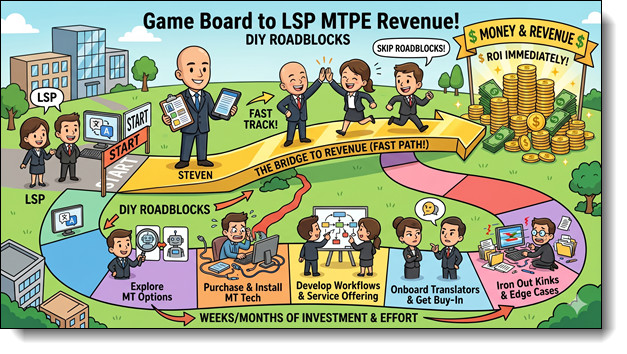
Skip the months of building. Use my pre-built bridge to drive revenue now.

By plugging your agency directly into my premium, on-call MT department with my GAIT-Augmented MT & MTPE services, you can instantly turn on the valve for Tiers 2 and 3. I handle the heavy engineering on a variable, per-word basis—delivering secure, context-aware machine translation with native formatting and glossaries intact.

You don’t wrestle with the technology. You just sell the solution, collect the revenue, and scale up later whenever you are ready.

Ready to bypass the DIY roadblocks and fast-track your 3-Tier Model?

Explore My On-Call MT Department Pipeline ➔

Got Questions? Let’s Unblock the Lanes

If there is a specific client scenario or workflow issue I haven’t covered below, just drop me an email. I’ll be glad to discuss it and help you map it out.

Will raw MT and half-price MTPE cannibalize my premium full-human sales?2026-06-04T11:25:43+00:00

Yes, it could—if you aren’t strategic about how you roll it out.

If you immediately pitch cheaper options to your best clients who are already sending you steady premium work, you risk upsetting a profitable apple cart. Instead, test this Three-Tier Service Model on dormant clients or those whose volume has significantly dropped.

Once you refine your workflow, however, offering lower tiers actually protects and grows your revenue. Here is why:

First, you become a strategic consultant. You aren’t simply cutting your prices; you are capturing a massive, previously untapped word count. By helping clients distribute their work across distinct tiers based on their actual needs, you deliver more total volume for the exact same budget (possibly “everything” they want to translate into every language they want to translate it into). You evolve from a simple order-taker into an indispensable content consultant.

Second, Tier 3 is a discovery engine. Raw MT acts as a lead generator for your premium services. When you process a client’s previously ignored, high-volume data through raw MT, they will inevitably uncover critical information they didn’t know they had.

Third, it creates automatic upsells. As soon as a low-cost draft reveals a risky legal clause, a critical technical spec, or hidden competitive intelligence, your client’s priorities instantly shift. What began as a casual, low-budget data run suddenly demands absolute accuracy. At that exact moment, you step in and upsell those specific, high-stakes documents to Tier 1 Premium Human or Tier 2 MTPE.

In this model, AI isn’t just translating content; it is exposing it. And exposing hidden, high-value content creates an automatic, ongoing pipeline for your human precision. Across all these service tiers, you are “solving” your client’s multilingual content problem. They no longer have to think about each task; you just get it done as their one-stop source for everything. That’s a partnership, a consulting service, and a paradigm for the future.

What if they want Tier 2 (or even Tier 3!) pricing but expect Tier 1 perfection?2026-06-02T04:27:22+00:00

You solve this by setting ruthless boundaries from day one. Forget about rigid ISO standards written by out-of-touch localization bulb-heads trying to strangle the delivery of value, and throw out confusing misnomers like “light post-editing” or “full post-editing.” This framework is not about academic definitions; it is about defining exactly what your clients actually want and giving it to them.

You lay out the choices with total clarity. If they want a massive value dump of highly readable text—and can accept that there might be problems with nuances and meaning—they choose Tier 3. If they need to be sure the translation is objectively right and accurate but are OK if the text hasn’t been fully polished, they choose Tier 2. But the boundary here is firm: clients choosing Tier 2 do not get to bicker about subjective style, phrasing, or flow. Finally, if human perfection, creative nuance, and flawless correctness are all top priorities, they must pay for Tier 1.

Emphasizing these stark distinctions upfront prevents quality disputes and trains your clients to buy based on their actual business needs rather than just looking at the price tag. And because you’re providing all three tiers, you get to sit down with your client and help them route their content into the right lanes.

Why provide Tier 3 at such a steep discount?2026-06-02T04:28:36+00:00

Think of Tier 3 as your ultimate volume magnet. It captures the massive, low-budget, internal data dumps you would otherwise lose entirely to free machine translation. But do not mistake this for a loss leader. Because of the efficiency of your new backend pipeline, you can make fantastic margins on high volumes even at these reduced rates. Once a client experiences your delivery on these projects, it becomes a natural, trusted bridge to upsell Tier 1 and Tier 2 services for their high-impact content. Furthermore, this tier serves as the perfect anchor for a monthly retainer. You can charge a flat recurring fee to process all their day-to-day internal content, securing predictable monthly revenue while positioning yourself perfectly to grab the higher-tier work when those critical needs inevitably arise.

Do I need to overhaul my CAT tools or IT infrastructure to make this work?2026-06-02T04:32:18+00:00

Not at all. That is the entire point of the pre-built bridge that I’ve already made available to you. There is zero system setup, zero IT maintenance, and zero staff learning curve required on your end. You simply route the files to me. I process them securely overnight and hand you back perfectly formatted drafts ready for Tier 2 MTPE or Tier 3 Raw MT delivery. You keep your existing workflow; I just act as your hidden high-speed engine.

How can I use this model to secure recurring revenue?2026-06-02T04:30:01+00:00

You achieve this by bundling your service tiers into a predictable monthly fee, which effectively removes purchasing friction. For example, you can structure a monthly offer where a client makes a base commitment for your premium human and turn-key MTPE work. On top of that, you can pitch an “unlimited MT” add-on, protected by a “reasonable use” clause. By committing, they also get a big discount across all “a la carte” services, and you can manage your own risk by starting them on a three-month trial contract. The easiest place to start selling this is through a “reactivation play” aimed at clients whose volume has dropped over the last one to two years. Set the retainer close to their historical average monthly spend. This is a brilliant pitch because they do not need new budget approval, but they instantly receive amazing new value.

What if a client still insists on doing it themselves in a chatbot?2026-06-02T04:22:18+00:00

Don’t fight it; monetize it. Offer them a “Tier 4: The DIY Prompt”. Charge your premium consulting hourly rate to build them the exact, custom “anchor prompt” they need to paste into ChatGPT for their internal use. You get paid for your strategic expertise (or mine, if you subcontract the task to me) and cement your status as their ultimate AI consultant. When they inevitably get tired of the management headache and workflow complexity, you are perfectly positioned to take over the pipeline with Tier 3. 

How do I pitch this to existing clients without them thinking my old rates were a rip-off?2026-06-02T04:23:06+00:00

You frame it as a strategic expansion of your capabilities, not a discount. You explain that your Tier 1 Premium Human service remains the exact same high-touch, prestigious service they require for high-risk, high-impact content. But now, because you have invested in an enterprise-grade backend, you can finally help them process the massive backlog of low-risk, internal content they previously couldn’t afford to translate. It’s about matching the right tool to the right task, not slashing your worth.

How do I guarantee data security when selling these new tiers?2026-06-02T04:24:42+00:00

Direct clients buy solutions, not management headaches, and that includes silent security. When you plug your agency into my MT department, every word is processed within a closed-loop, confidential AI system. Unlike the free DIY tools your clients are currently using, their proprietary data never becomes part of a public training model. You get to leverage this “enterprise-grade security” as one of your biggest selling points.

What’s the easiest way to get started with this model?2026-06-04T11:38:55+00:00

The absolute easiest way to get your new service stack in front of clients is to start with the ones who already know your worth but have quietly slipped away. The reality of the current market is that many clients left because they thought ChatGPT was a free alternative. But right now, they are likely drowning in cheap AI slop and realizing that free AI actually costs their bilingual employees valuable time and money.

Instead of dropping your rates or begging for the work back, you should deliver full-spectrum value through a “reactivation play”.

Here is exactly how to structure and execute this approach:

First, identify the target. Reach out to those direct clients whose translation volume has dropped significantly over the last one to two years.

Second, structure the pitch. Do not pitch an entirely new, unfamiliar package. Instead, bundle your new service tiers into a predictable monthly retainer set close to their historical average monthly spend. You might frame this with a base monthly commitment for premium and turn-key MTPE work, and a small add-on for high-volume raw MT.

Third, highlight the core benefit. The brilliance of this pitch is the reduction in purchasing friction. Because the retainer matches what they used to spend, they do not need to fight for new budget approval. They simply sign a short, low-risk trial contract, like a 3-month trial, and get massive new value for a budget line they are already used to managing.

You then spend the next three months guiding them to identify content to translate, channeling it into the appropriate service tier, and helping them get as much value as possible from you. This boosts their bottom line, makes their life easier, and turns you into an indispensable partner way past the 3-month trial.

By targeting these specific clients, you eliminate the friction of cold outreach and position yourself not as a vendor asking for work, but as a strategic consultant who has done the work to upgrade to the new paradigm and is now returning with a highly efficient, budget-friendly solution that solves the exact AI headaches they are currently experiencing.

With the Three-Tier Service Model work for any client?2026-06-07T06:30:28+00:00

No model works for everyone. This framework is optimized for clients who already have significant volumes of content (both backed up and on an ongoing basis), and who would have far more of it translated professionally if the quality, price, and operational reliability were better aligned to their business goals. It targets the untapped budgets of clients who need scalability at a lower cost and with higher standards.

However, don’t assume a client’s current translation needs based solely on their past behavior. Offering three levels of service—even to clients approaching you with simple, one-off projects—does more than just make you more competitive during the initial bidding process; it awakens them to new strategic opportunities, drawing out high-volume content for translation that wasn’t previously visible. With this service model, you can initiate a consultative conversation with your clients to help them maximize their multilingual content opportunities.

Go to Top