
If you are a veteran translator, MTPE might feel like a step backward: lower rates, more cognitive load, and less creative joy. I fiercely resisted it myself.
But the market has changed. The sheer volume of content being created today is exploding, buyers demand faster turnaround, and machine engines have improved dramatically. Hoping clients will reject semi-automated workflows and return exclusively to premium rates is a dead end. If veteran translators refuse to serve this growing middle market, the work won’t disappear; it will simply default to the cheapest, most heavily automated vendors buyers can find.
We have a genuine opportunity to actively improve our value proposition within this new market.
I have built a different approach: a premium, human-driven service that pairs boutique LSPs directly with their own trusted veteran translators on a workflow I call GAIT-Augmented MTPE.

Steven S. Bammel, PhD
Fellow Translator
Yes, it is still post-editing; it’s not magic. But instead of forcing you into a rigid, machine-first box, this approach is designed around your existing workflow, your expertise, and your timeline. It fundamentally shifts the dynamic from taking orders from a machine to making a difference in an organic workflow.
While this will require a mindset change, please keep an open mind as you review exactly how this workflow improves your daily work below. I hope to work with you soon.
Make the Saves that Clients Actually Care About
Without burning out on unnecessary dives
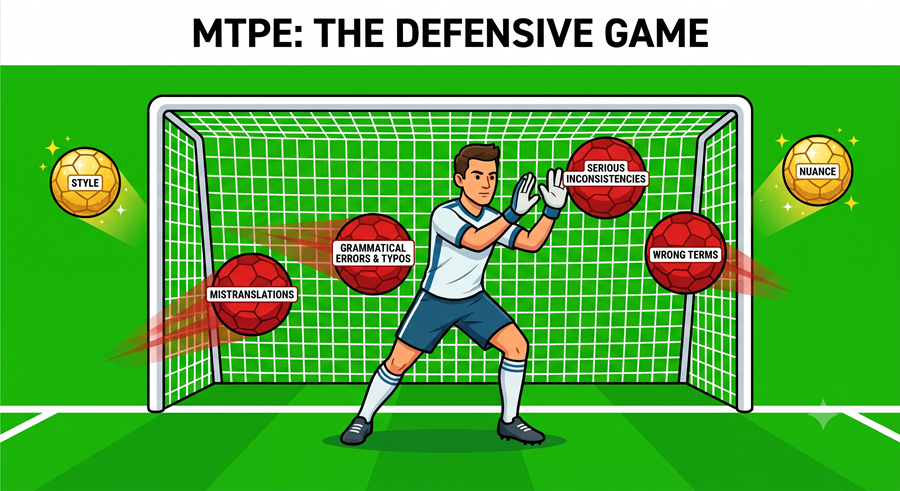
MTPE is a defensive workflow
When you approach MTPE with a traditional artisan mindset, you get stuck in the weeds. Wrestling machine output into your own personal style creates a huge cognitive load. MTPE clients aren’t paying for invisible brilliance, and they probably couldn’t tell the difference anyway. What they want is usable accuracy. If you spend your time obsessively polishing text that is already “good enough,” you are essentially doing unpaid work and will quickly burn out.
To survive and thrive, you have to drop the perfectionism and realize that you are playing defense. Think of yourself as a goalkeeper. You will not be praised or rewarded for delivering brilliant, highly nuanced offensive plays. Instead, you will only be criticized for objective mistakes that slip past you and hit the back of the net. Instead of asking, “Can I make this as good as it can possibly be?” start asking, “Is this accurate and readable?” You are not lowering your standards; you are simply pointing them at what the client actually wants.
When deciding whether to make a change, ask yourself: “If I do not make this edit, will it open me up to criticism that I cannot objectively defend?” Blatant mistranslations, broken grammar, or glossary failures are direct shots on goal that you must block. But if the answer is no, accept the AI’s output and move on.
To protect your energy, you must stop guessing. Do not ask yourself what subtle nuance the author might have had in mind or how you can elegantly capture it. Conjecture and stylistic flair are not appreciated or compensated in this format. Your sole mandate is to protect the document from undeniable errors.
Once you make this adjustment, you become a strategic editor—the ultimate human firewall keeping the net clear. By matching your effort to your rate, leaning on the AI, and pushing forward through the document, the work becomes profitable and even enjoyable. Your career experience as a translator then positions you to capture your portion of the growing volume of MTPE content without wearing yourself out.
A Message to Veteran Translators
Why traditional translation rules will burn you out on this project, and how to protect your time by embracing “pragmatic efficiency.”
How Does GAIT-Augmented MTPE Make My Post-Editing Work Better as a Translator?
Smoother operational workflow, improved translator experience, and superior final product
Conventional machine translation is an automated, static process that produces disconnected text and turns highly skilled translators into mechanics forced to clean up a machine’s mess. My premium approach is fundamentally different. I use my highly curated, iterative GAIT workflow to remove much of the friction from your plate and deliver contextually fluent drafts right out of the gate, and even get better as we go. When we approach machine translation post-editing this way, everybody wins.
Here is exactly how this process improves your daily work:
|
|
Work in your preferred toolMy GAIT-Augmented MTPE workflow can provide files for post-editing in virtually any relevant format: 1) bilingual Word files with the source on the left and MT on the right if you prefer not to work in a CAT tool. 2) .xliff files to process inside your CAT tool of choice, leveraging any resources you wish. 3) Final, target-language files for post-editing so you can simply check the source document against the target document outside of a conventional segment-based editing environment. 4) Your boutique LSP’s online TMS system for online editing. Having choices is the very first step in improving your post-editing experience. |
 |
No more “Frankenstein Effect”Standard systems translate segment-by-segment with little context, independently mixing exact matches, fuzzy matches, and raw MT, forcing you to act as a tailor stitching together disjointed text. Instead, I translate in broad, context-aware blocks. By feeding translation memory hits and a “gold standard” sample—ideally incorporating your own translation work—into an anchor prompt, the AI generates the entire document in a single, cohesive, and highly fluent voice. |
 |
Fewer formatting headaches, better segmentation, and no “tag soup”Automated systems are notorious for breaking segments, losing critical formatting, and creating frustrating tag soup, not to mention OCR errors. I treat source text preparation as a crucial, manual step. Before you ever touch the file, I meticulously prep the text by correcting segmentation, stripping out unnecessary tags, locking out high-value internal fuzzies, and locking in the original formatting. You are freed from tedious, time-consuming cleanup tasks. |
 |
Dynamic, iterative supportStandard MT is a completely static, one-way street where you are stuck with whatever errors the engine produces from beginning to end. As a large project progresses in my workflow, I actively tweak and improve the AI prompt based on your ongoing feedback. If you identify a structural problem or new terminology early on, I can improve the machine output on the very next batch of text. |
 |
Elevating you to a strategic editorUltimately, these structural changes are designed to elevate your experience. Instead of being relegated to the role of a “janitor” fixing endless mechanical glitches, you act as a strategic editor. Because the MT is directed toward the desired style and stripped of structural friction, your cognitive load drops, especially as you adopt a post-editing mindset. With your collaboration, we share a sense of ownership in the process. This allows you to work faster, experience more job satisfaction, and focus your energy on delivering better work. |
 |
On-call coaching and guidanceIf you’re new to this, I’d like to help you make the leap to a new way of working. With your boutique LSP client’s permission, I am available for coaching and to answer your questions along the way, ensuring you feel fully supported as we navigate the post-editing process together. |

How to Survive (and Improve) MTPE Projects That Don’t Follow a Best-Practice Workflow
Hint: CotranslatorAI is your best friend in these cases.
The mindset shift to pragmatic editing assumes the machine translation you receive is actually cohesive and adequate. Unfortunately, the market reality is that many clients feed poorly prepared source text through general MT engines and expect you to clean up the mess.
Scenario A: When You Can Start From Scratch
If you receive an MTPE project with completely unusable output, your fastest route to profitability might be to scrap the client’s translation and start over entirely. By running the text through the Generative AI Iterative Translation (GAIT) workflow on your own system and applying that pragmatic “Is it readable and correct?” editing standard to your own AI drafts, you can generate better work, double your speed, and easily keep the project profitable for yourself.
Scenario B: When You Are Locked Into a Client’s TMS
However, as translators, we are often locked into our client-mandated, restrictive online post-editing environments. When you cannot translate from scratch, CotranslatorAI is your lifeline. Instead of agonizing over terrible output segment-by-segment, you can use CotranslatorAI’s keyboard shortcuts and highly customized prompts to have the AI clean up the client’s inferior translation before you do any manual editing. Translators using this approach report that feeding the source segment or bad MT back to the AI with specific, optimized instructions resolves quality issues, maintains specific tone, and eliminates the heavy manual corrections that can make low-rate jobs unfeasible. To see exactly how to implement this in your own setup, check out the Generative AI Machine Translation Post-Editing (GAIM) workflow or explore the Creative-Control Translation Flow to learn how to adapt these AI-driven strategies directly inside your current CAT tool.

