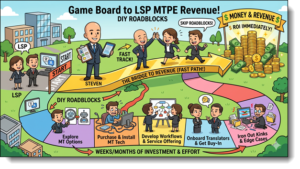
New technologies, platforms, and service models give boutique LSPs more ways than ever to deliver translation, but they also introduce a confusing range of options and make complex projects harder to manage well. Keeping pace with rapidly changing tools, AI capabilities, file formats, linguistic requirements, and quality workflows is difficult without dedicated technical staff. And having access to powerful technology is not enough: delivering real value still depends on knowing how to combine the right tools, resources, and human expertise into a workflow that is efficient, reliable, and fit for purpose.
A Language Workflow Specialist bridges that gap—in my case, as a flexible outsourced resource you can call on when you need it. Drawing on more than 25 years of experience as a technical translator, I provide human-first workflow design, production, processing, and AI-augmented translation support. This helps you take on difficult or unfamiliar projects, strengthen quality and consistency, and benefit from emerging technologies without hiring specialized personnel or carrying additional overhead.

Steven S. Bammel, PhD
Language Workflow Specialist
Flexibility, Within Complexity
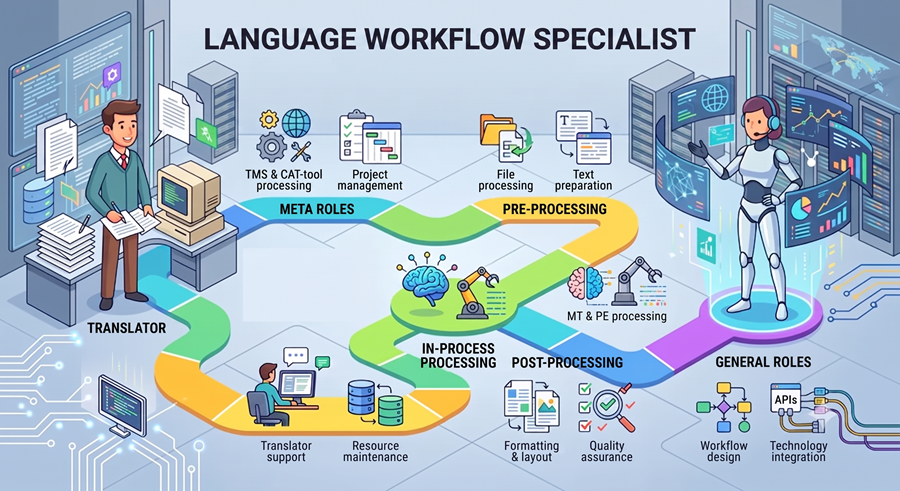
Ask a business guru today what the key to success is in the AI era, and they will likely say “coordination.” This means that, in addition to the trust you’ve built up in human relationships, deep experience in languages, and understanding of translation workflows, you must also excel at coordinating services for your clients and delivering value with ever-greater precision. But if you get bogged down in the details of every new technology, role, workflow, and technique, you cannot perform in ways that will set you apart.
I bridge the gaps in your production capabilities, enabling you to offer and deliver greater value to your clients. By designing better workflows and executing both routine and cutting-edge processes, I serve as your Language Workflow Specialist, strengthening your competitiveness while freeing you to focus on the areas of your business where you have the greatest advantage.
End-to-end coordination functions
End-to-end workflow coordination encompasses the overarching management a Language Workflow Specialist provides across the entire life cycle of a project. These functions are typically contracted on a per-project or per-end-client basis and frequently incorporate the specific tasks and services detailed below.
FUNCTION: File and CAT-tool processing
File and CAT-tool processing in a boutique LSP is usually handled by a project manager. For routine work, this is often the most efficient approach. However, as the PM’s role grows increasingly complex, delegating this specific function may deliver greater value—especially on technical and complex projects. In a fast-paced environment, PMs rarely have the bandwidth to master advanced CAT features, architect optimal workflows, and execute technical setup with complete precision, while also handling everything else that goes into managing a complex project.
This is where a Language Workflow Specialist steps in to lighten the load, bringing technical focus that prevents costly inefficiencies and delivers greater value to your end-clients.
For small, owner-operated LSPs focused primarily on sales and client service, this gap is even wider. Handing off the entire process directly to individual translators destroys the benefits of centralization—cost savings, strict quality control, and asset consistency. A Language Workflow Specialist restores structural integrity to your pipeline, ensuring every file is processed strictly on spec as clients demand increasingly customized workflows.
When a Language Workflow Specialist can help with file and CAT-tool processing
- Preparing CAT-tool workflows for translators who don’t use CAT tools, so they can work in an accessible format while you retain centralized control of translation memories, terminology, and file preparation.
- Handling files with complex code or structures, such as heavily formatted Excel workbooks and non-standard XML files, while protecting non-translatable content and preserving the required output structure.
- Preparing SRT and other timed caption files so translators can focus on the text without struggling with broken segmentation or accidentally altering timestamps.
- Processing multilingual source files whose translations must be delivered in a single file, avoiding inefficient manual copying and pasting and reducing the risk of omissions or misplaced content.
- Integrating AI translation with translation memories and termbases to support consistent terminology and style, avoiding the “Frankenstein Effect” of mismatched text assembled from different translation sources.
FUNCTION: Extended-hours workflow coverage
Keep urgent and complex translation projects moving when your office is closed or your team is stretched. Whether you face a workload spike, an unexpected staff absence, or a demanding assignment across several time zones, an on-call Language Workflow Specialist can provide temporary or recurring support. Depending on location, this resource can complement your team’s business hours to help provide 24-hour coverage, or simply serve as an off-hours contact for translators and clients.
The scope can be as narrow or as extensive as you need. A Language Workflow Specialist can receive and check incoming files, prepare work for the next production stage, answer workflow questions, communicate instructions, monitor progress, and coordinate handoffs. For complicated projects, direct contact with translators helps resolve issues without routing every exchange through an internal team member who may be unavailable or occupied with other priorities.
Your team retains control of the client relationship and core operations. You agree in advance on coverage hours, communication channels, decision-making authority, and escalation procedures. Your staff is copied on correspondence and receives a clear handover, so they know what has been completed, what has changed, and what needs attention.
This support is modular: use it for a single rush assignment, bridge a temporary staffing gap, or arrange recurring coverage outside your normal business hours. You gain capacity where and when it is needed without the overhead of maintaining idle, “just-in-case” staff. Translators spend less time waiting for answers, clients have someone to contact, and your internal team has more room to focus on its own responsibilities.
Production pipeline
The production pipeline encompasses the individual tasks required to execute a project from start to finish. While the workflow described below is modular—with specific tasks added, adapted, or omitted based on project requirements—it represents the core components of an enterprise-grade localization process. For routine projects, these tasks can be coordinated directly by a project manager; for larger, more technical, or highly customized assignments, they are best executed in direct collaboration with a Language Workflow Specialist.
Pre-production tasks
Some of the most high-value, underutilized opportunities for workflow optimization exist in the pre-production stage. Because these tasks are often technical, tedious, and time-consuming, busy PMs are frequently forced to rush or skip them altogether. However, shifting this burden onto translators—or neglecting file prep entirely—forfeits the speed, cost savings, and quality enabled by a best-practice workflow. As part of an end-to-end processing function, a Language Workflow Specialist handles this heavy lifting up front, ensuring every project is set up for maximum efficiency from day one.
TASK: Source file processing
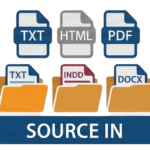
Source file processing typically fails for two reasons: a lack of bandwidth for tedious detail, or high technical complexity.
First, preparing clean source files requires a level of sustained focus that is hard to maintain during a busy project manager’s day. When time is short, it is tempting to run a quick conversion—or skip it entirely—and leave translators to sort out the mess. Poorly converted PDFs, for example, carry erratic spacing, hard line breaks, and OCR errors into the CAT tool. Shifting this cleanup onto linguists creates inconsistencies, as every translator resolves formatting errors differently. Worse, paying multiple translators to fix the exact same source file jacks up costs for every target language in the project. If you don’t pay them for it, they are incentivized to take shortcuts, degrading output quality. Centralizing file cleanup through a Language Workflow Specialist ensures a clean source text, consistent handling across all target languages, and lower overall spend.
Second, when clients submit complex Excel files, custom XML, or non-standard file formats, not knowing how to configure the correct CAT tool filters (or pre-process the files outside the CAT tool) can stall an entire project. Lacking fast, specialized technical support leads to bloated production costs, delivery delays, or even turning away work altogether. A Language Workflow Specialist handles these technical edge cases daily, knowing how to parse, isolate, and process even the most complex file structures. By resolving technical friction up front, your internal team and linguists can execute their standard roles smoothly without getting bogged down by file headaches.
TASK: Source text preparation
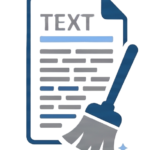
Even after a file has been properly converted, additional preparation of the source text may still be required. This includes correcting segmentation, removing high-value internal fuzzy matches, and identifying and resolving errors or ambiguities in the original material. Proper text preparation corrects issues before translation begins, preventing bloated costs and inconsistent target output. A cleaner source text also allows existing translation memories and termbases to leverage matches more efficiently. Ultimately, maximizing alignment between the source text and your language assets yields cleaner TMs and glossaries, ensuring that the work done today pays dividends on future projects.
Just like source file processing, unresolved source-text issues are multiplied across every target language in a project. A Language Workflow Specialist prepares the source text using industry best practices—frequently leveraging specialized third-party tools and proprietary routines—wherever source defects could compromise downstream accuracy and fluency. Refining the source text removes friction for translators, reduces payable word counts, accelerates turnaround times, and delivers a higher-quality final product to your end client.
Production tasks
With traditional human workflows of the past, production tasks were simply outsourced to individual translators, a model many boutique LSPs still follow on many jobs. However, centralizing these tasks within a structured, AI-augmented pipeline can do more than reduce costs. When best-practice pre-production, context-aware AI translation, and expert human post-editing are combined, most projects achieve near-human quality at higher speed. These advantages become especially pronounced on large or multilingual projects involving multiple linguists. Rather than leaving each translator to make isolated decisions across their section of the job, a centralized AI translation process establishes a unified foundation for terminology, style, and project specifications from start to finish across the entire word count and all target languages. The result is a more cohesive, consistent deliverable than a decentralized translator-by-translator approach could ever produce, at a significantly lower cost for your end client.
TASK: AI translation
In many conventional machine translation workflows, the CAT tool pulls translation memory and termbase matches from disparate databases, leaving fuzzy matches for the translator to resolve or inserting new translations with basic engine assistance. For un-matched segments, generic or poorly trained machine translation generates terminology and style that fluctuate from sentence to sentence. The result is a “Frankenstein translation” where every segment has a different genealogy, rife with mistakes and inconsistencies.
There is a far better approach. Utilizing a human-directed, context-aware AI workflow—such as GAIT-Augmented MT—a Language Workflow Specialist builds an anchor prompt that unifies translation memory, glossary terms, style guides, formatting parameters, and document-level context into a single, cohesive framework. A high-quality “gold standard” reference translated or approved by a linguist can be injected from the start, providing the AI with a model for tone, voice, and domain-specific phrasing. Maintained across the project and dynamically refined as work progresses, this anchor prompt delivers high-quality, contextually aware AI translation that is more coherent and accurate than conventional segment-by-segment MT.

TASK: Post-editing processing
For premium projects, human post-editing is added to achieve higher trustworthiness of meaning for publication-ready quality. Standard MTPE workflows often reduce skilled linguists to cleaning up mechanical errors and disjointed output. In contrast, the GAIT-Augmented MT workflow supplies post-editors with a well-prepared, contextually fluent draft from the outset. With formatting preserved, tags controlled, and terminology pre-aligned, linguists can devote their expertise to nuanced linguistic refinement rather than tedious repair work.
The post-editing handoff is entirely flexible and platform-agnostic: linguists can work within their preferred CAT tool, bilingual Word files, your client’s TMS, or directly in the target files. On multi-batch, high-volume projects, feedback from initial rounds is fed back into the anchor prompt, continuously raising the quality of subsequent batches in a dynamic improvement loop. Direct support from a Language Workflow Specialist can also help your veteran translators transition smoothly from a “my version of perfect” full-human translation mindset to high-value strategic editing.

TASK: Target text consolidation
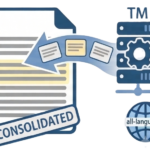
Once human post-editing is complete, the target text must be consolidated across the entire project. The finalized segments are imported into the CAT tool to populate a dedicated working translation memory that contains only the linguist’s vetted output. Managed by a Language Workflow Specialist, previously locked duplicates, internal fuzzy matches, and non-translatable segments are then reconciled against this project TM, preventing older or lower-quality translations from overwriting the final wording.
Consolidation follows a controlled sequence. First, exact matches are propagated so every duplicate reflects the linguist’s final edits. A further pass captures masked near-duplicates whose match scores were artificially reduced by OCR errors, tag variations, or formatting differences. Finally, all numbers, symbols, tags, and non-translatable elements undergo a final check. This cascading process extends human-approved terminology, style, and phrasing into every corner of the project, producing a complete and internally consistent target deliverable.
Post-production tasks
Post-production encompasses all work performed after the translation is complete, whether the project relies on raw machine translation, post-editing, or traditional human workflows. The exact scope depends on project specifications, with steps like in-context review or specialized desktop publishing scaled or omitted as needed. Executing these final stages under the direction of a Language Workflow Specialist ensures target files are properly generated, verified, and delivered strictly on spec, protecting deliverables from last-minute technical errors before they reach the end client.
TASK: Linguistic quality control and remediation
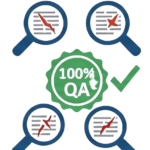
Linguistic quality control and remediation begins with the standard automated checks available in the CAT tool, including reviews of terminology, consistency, numbers, punctuation, tags, and missing or incomplete translations. Many issues can be corrected immediately, and carefully designed AI prompts may assist with investigation or remediation when the project manager or Language Workflow Specialist does not speak the target language. However, AI-assisted changes must be applied with appropriate oversight, and issues involving meaning, nuance, or language-specific judgment may require further consultation with the translator before the text is finalized.
One particularly effective, though time-consuming and somewhat costly, option is to process the translation through an AI quality-control tool. These tools can generate extensive feedback that must still be reviewed and resolved by a qualified linguist, adding another stage to the workflow. Alternatively, AI quality control can be applied to the initial AI translation, with its findings provided to the post-editor as targeted guidance. Such tools classify segments according to their likelihood of requiring attention, and with a strong machine-translated draft, typically only about 25 percent may be flagged for further review.
This enables a more selective approach in which only the flagged segments are sent for human post-editing, while the remaining 75 percent are accepted based on the AI translation and quality-control assessment. Although this can significantly reduce turnaround time and cost, it carries greater risk than comprehensive human review because unflagged segments are not checked by a human. The appropriate integration of AI quality control should therefore be agreed upon by the LSP and end client based on the project’s purpose, content sensitivity, quality requirements, budget, and acceptable level of risk.
TASK: Target file processing
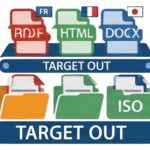
Once the translation has been consolidated and verified, the target text is exported back into its original native file format. Segments that were temporarily joined during preparation may be returned to their correct layout positions using embedded markers, preserving native tags and inline formatting. Managed by a Language Workflow Specialist, this step constructs the file without compromising its underlying structure, even in complex documents like Word files originally converted from PDFs.
Target file processing prepares the project for final delivery or subsequent in-context polishing, DTP, and formatting QC. While it restores the document’s native structure, it does not cover manual desktop publishing tasks such as fixing page breaks, resizing text boxes, or adjusting layouts for text expansion.
From the standard workflow by the Language Workflow Specialist, final handoff here can include the target deliverables, intermediate workflow files, and updated translation memory, providing an audit trail and ensuring that the client retains full ownership and control of all project assets.
TASK: Formatting quality control and finalization
The final step after exporting the target file from the CAT tool is ensuring that the deliverable is fully ready for distribution. In straightforward projects, this may require only a quick visual inspection for unexpected formatting or other obvious visual flaws. More complex files require a higher level of technical intervention. A desktop publishing (DTP) specialist may need to adjust layouts in professional design software, ideally followed by a final post-layout review by a qualified linguist.
Files created by converting PDFs to Word are particularly prone to formatting anomalies and often require careful remediation by someone who understands the target language and can properly account for text expansion, line breaks, and overall content flow. Depending on project scope and resource allocation, this work may be handled by the translator, a dedicated formatting specialist, or a Language Workflow Specialist.
Other file types demand specialized forms of finalization. Structured formats such as XML must be formatted and returned for upload directly into the client’s Content Management System (CMS). Depending on the agreement between the LSP and the end client, the pipeline may also incorporate a final in-context review post-upload or post-layout. This enables linguistic, visual, and functional issues to be caught and corrected within the digital environment where the translation will ultimately be viewed by end users.

Cross-functional support services
Cross-functional support services extend beyond individual translation projects. Operating as a Language Workflow Specialist, an outside consultant can design reusable workflow templates, establish software platform integrations, train LSP staff and translators, and optimize core assets like translation memories and termbases. Unifying technical workflow design, linguistic knowledge, and practical AI implementation ensures your operations remain efficient, adaptable, and fully equipped to meet evolving client requirements.
SERVICE: Workflow design
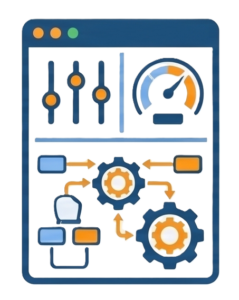
Workflow design is the detailed planning and configuration of every step in a translation process. The pipeline described above represents an archetypal translation workflow, and I have engineered several workflows around it based on the Generative AI Iterative Translation (GAIT) framework. Even within this framework, numerous decisions must be made to achieve the best possible results as efficiently as possible. Post-production requirements vary according to the project specifications, while pre-production depends on factors such as source file format, source text condition, and the availability and usefulness of linguistic resources. The production stage may include or omit AI translation, human post-editing, or both. Each combination requires different workflow decisions.
As a Language Workflow Specialist, I design workflows for a wide range of project specifications using advanced techniques in memoQ, other off-the-shelf software, custom routines, and AI prompting. Rather than forcing every project through a fixed pipeline, I adapt the sequence of tasks, tools, resources, and quality controls to the needs of the content, client, and intended use. At present, all the workflows I develop are derived from the GAIT framework, which provides a flexible foundation for integrating human expertise, AI capabilities, linguistic resources, and production technology.
Know what the job requires before you quote
Have a complex translation project to quote? Bring me in before you commit. I can review the client’s instructions, analyze the files and available resources, and map out optimal workflow options. You get the key details needed to build a well-grounded quote and organize delivery: recommended production steps, tools, staffing needs, quality controls, and any risks or open questions that could affect cost or timing.
This is available as a standalone, paid analysis. You do not need to hire me for the translation or implementation. Your team can use the plan to mobilize the right resources and move forward efficiently. When competing for a difficult project, knowing how you will deliver it gives you a stronger basis for quoting than guesswork.
SERVICE: Workflow and technology training
In addition to patience, attention to detail, and sustained focus, executing these workflow tasks as a Language Workflow Specialist requires software dexterity, linguistic insight, technical proficiency, and a clear grasp of the end-to-end production pipeline.
Software dexterity extends beyond basic CAT-tool usage, encompassing advanced platform features alongside specialized utilities like Microsoft Office, Adobe Acrobat, TransTools, CotranslatorAI, LanguageCheck.ai, and many more. My linguistic insight is built on over two decades of hands-on experience navigating the intricacies of translation, editing, terminology management, and multilingual production.
Technical proficiency means understanding how generative AI operates, where its limitations lie, and how to integrate it responsibly into human-directed workflows. Today, boutique LSPs and veteran translators have access to remarkably powerful technology, enabling us to deploy sophisticated pipelines without enterprise-scale infrastructure or blind automation. Equally crucial is an end-to-end perspective on production—understanding human workflow dynamics, client requirements, and where different translation methodologies offer advantages or introduce risks. My perspective was forged through decades of translation work, refined through the recent shift toward AI integration, and proven through educating industry peers and delivering these very workflows reliably.
When a boutique LSP is ready to build these capabilities internally, I can design and execute training programs. Whether the objective is to adopt a complete workflow or build targeted proficiency in specific tools and techniques, training can be customized to align directly with your existing staff, technology, and operational goals.
SERVICE: Translator support
Many translators are struggling to adapt to the forces reshaping the language industry today. They are understandably asking whether traditional work will disappear or whether adopting new roles and technology might actually unlock access to volumes of work that were previously uneconomical. Having presented to thousands of translators and worked directly with hundreds, I have helped linguists update both their mindset and technical skillset for the AI era. This includes leveraging tools like CotranslatorAI for high-efficiency human translation, adopting innovative new workflows, and developing practical strategies for transitioning into new roles.
As a Language Workflow Specialist, my guidance to translators on MTPE is grounded in best-practice post-editing, where the LSP first establishes a strong, context-aware AI translation baseline so linguists can apply their expertise to meaningful editorial decisions. It stands in stark contrast to automated approaches that push low-quality engine output onto translators at slashed rates while expecting publication-ready results. When translators realize that greater efficiency can generate higher volumes of sustainable work—and learn to collaborate with boutique LSPs to deliver on-spec post-editing with less cognitive strain—they become valued strategic partners rather than a cleanup crew. Combining hands-on translation experience with technical workflow expertise creates a unique ability to guide veteran linguists through this transition. For post-editing projects that I manage through the GAIT-Augmented MTPE workflow, this translator guidance and support is built directly into my process.

SERVICE: Resource management
Clean underlying data and well-maintained language resources are frequently cited as prerequisites for success in localization. While that holds true for enterprise providers operating massive, low-touch machine translation programs, boutique LSPs require a different competitive strategy. Your core differentiator lies in human oversight, veteran linguistic expertise, and agile workflows that can be deployed rapidly and adapted continuously. The GAIT-Augmented MT and MTPE methodologies are engineered around this principle. At the scale typical of boutique LSP engagements, access to intelligent workflow design and skilled post-editors yields a higher return on quality than maintaining oversized, unwieldy language databases for automated processes.
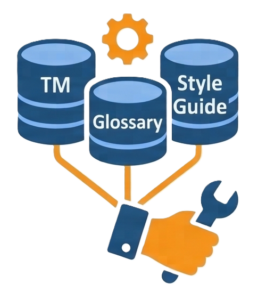
At the same time, up-to-date translation memories, termbases, and style guides remain vital assets—particularly for recurring accounts that require strict terminology control and consistent brand identity. These resources reinforce prompt design, provide clear guardrails for both AI models and human linguists, and gain value as they are refined over time. Operating as a Language Workflow Specialist, I can assess, clean, update, and maintain these core assets, ensuring they support long-term quality and operational efficiency without restricting your workflow flexibility.
Ready to access your own language workflow back office?
Scale faster with human-directed AI translation, MTPE, and outsourced workflow support.
My On-Call Language Workflow Back Office gives you a plug-and-play production process built around trained, context-aware AI and human expertise. Leapfrog the difficult up-front work, take on more projects from a position of strength, and retain full ownership of your data and language assets. If you later bring work in-house, the workflows and resources remain yours, and I remain available as your safety net when capacity, complexity, or deadlines demand extra support.