The language industry is fragmenting. With new technologies, platforms, and shifting markets, today’s translation consumers have access to unprecedented resources. But they also face a confusing array of options in an area of competency they are unfamiliar with, and usually don’t want to learn. In a market where standing still means falling behind, every participant, from translators to boutique LSPs, must adapt.

Keeping up with this rapid evolution is difficult. For a boutique LSP without the overhead to hire dedicated, in-house staff for every new technical requirement, staying on top of complex workflows is a challenge. This makes strategic outsourcing more important than ever.

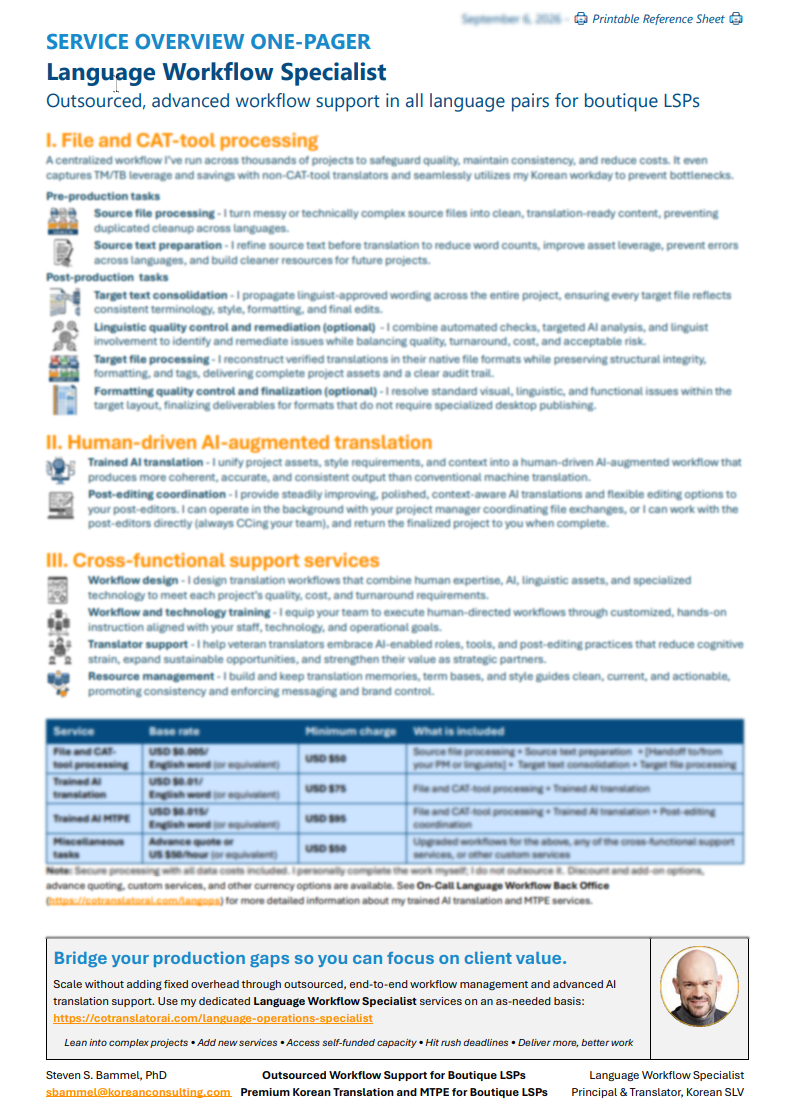
This page outlines the specific roles a Language Workflow Specialist can take on to bridge that gap. My own background is rooted in language—I began as, and still am, a freelance technical Korean-to-English translator. This allows me to handle the technical side of the translation process with a distinctly human-first philosophy.

The following sections detail the workflow, production, and processing roles I now offer to my boutique LSP clients to give them a flexible, technological edge. I welcome your feedback on these roles, as well as any thoughts on other emerging needs you see in the market.

Steven S. Bammel, PhD

Steven S. Bammel, PhD
Language Workflow Specialist

Flexibility, Within Complexity

What a Language Workflow Specialist provides today’s boutique LSPs

Ask any business guru about the key to success in the AI era, and they will likely point to coordination. Boutique language service providers (LSPs) must excel at coordinating services for their clients. But if they become bogged down in the details of every emerging technology, role, workflow, and technique, they cannot fulfill the higher-level coordination role that gives them a competitive advantage.

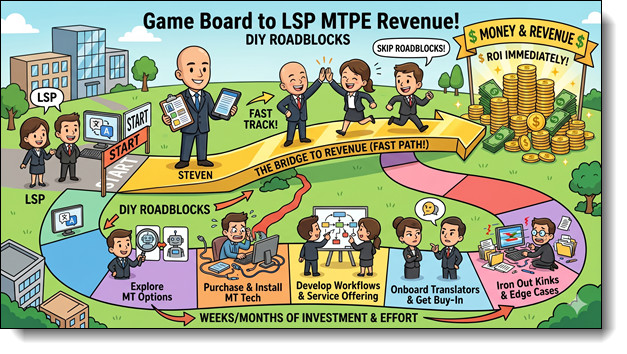
A Language Workflow Specialist fills gaps in a boutique LSP’s production capabilities, equipping the LSP to deliver greater value to clients. By designing workflows, providing current industry insights, and executing both routine and cutting-edge processes, the Language Workflow Specialist strengthens the LSP’s competitiveness while allowing the LSP to focus on its own competitive advantages.

End-to-end workflow coordination

End-to-end workflow coordination includes the tasks a Language Workflow Specialist provides across multiple steps of a project. These roles are usually best contracted at the project-unit level and often include some (or even most) of the other roles outlined below.

TMS/CAT-tool processing

TMS/CAT-tool processing in a boutique LSP is usually handled by the project manager. Indeed, this is often the most efficient workflow for routine projects. But in many cases, splitting the roles would deliver more value, especially on complicated projects, and as the already-complex project manager’s work is becoming more complex by the day. In a busy work environment, a project manager does not always have the time and attention to learn the advanced features available in today’s advanced tools, plan out workflows to optimize for productivity, and then actually execute the work as well.

This is where a Language Workflow Specialist can step in and lighten the project manager’s load. In many cases, TMS/CAT-tool processing overlaps with, and is indivisible with, other roles listed below, such as file processing, text preparation, or even machine translation processing, which often require deep attention to detail to avoid leaving money on the table and deliver more value to end-clients.

This is especially true for very small LSPs where the owner-operator is more focused on sales and client service. When an owner-operator pushes the entire translation process off to individual translators, the LSP loses the benefits of centralization: higher consistency, lower costs, and stricter quality control. A Language Workflow Specialist can bring structure to the process and actually get the work done, especially as end-clients demand more workflow choices themselves.

One of the advantages of my Language Workflow Specialist support with AI workflows is that best-practice TMS/CAT-tool processing is built right in at no additional cost.

Project management

Even the best-run LSP occasionally experiences fluctuations in workload or unexpected changes in staff availability and may benefit from temporary support until circumstances return to normal. In other cases, a project whose other aspects are handled by the Language Workflow Specialist may also proceed more efficiently if the specialist serves as the project manager as well. This avoids inefficiencies from a project manager having to act merely as a file intermediary while execution and delivery are handled by the translators, Language Workflow Specialist, and other supporters.

The role is also flexible, since an LSP can outsource only certain aspects of project management while retaining others in-house. For instance, the Language Workflow Specialist may communicate directly with translators—while CCing the project manager or owner-operator—to prevent handoff delays, while the LSP’s staff continues to handle client communications and billing. All these arrangements can be negotiated with as much flexibility as needed to meet the project’s and the LSP’s requirements at the time, offering adaptability and reducing the need to maintain spare “just-in-case” capacity.

A Language Workflow Specialist based in a different time zone also allows the LSP to be more available to clients and translators worldwide. By collaborating with the LSP’s internal resources, a Language Workflow Specialist on the other side of the world can process work outside the LSP’s standard business hours, increasing throughput for large, ongoing projects, particularly those involving urgent deliveries.

Thanks to my location in Korea, working in a project manager role, I can add an entire shift every day to your availability, (or even holiday and weekend available, as necessary) both to clients and to translators.

Pre-production preparation

Some of the most underutilized opportunities for improvement in the boutique LSP workflow are likely found in the pre-production preparation stages. These tasks are often the most tedious and may require some of the most advanced optimization techniques. Consequently, when time is limited, they are often the easiest to skip. However, shifting these tasks to the translator—or neglecting them entirely—instead of completing them properly means forfeiting many of the potential benefits enabled by a best-practice workflow. A Language Workflow Specialist can help keep the process moving, especially as part of a full TMS/CAT-tool processing role.

File processing

[placeholder]

[placeholder]

Text preparation

[placeholder]

[placeholder]

Production and in-process support

MT & PE processing

[placeholder]

[placeholder]

Post-production review and delivery

Formatting & layout

[placeholder]

[placeholder]

Quality assurance

[placeholder]

[placeholder]

Cross-functional support

Workflow design

[placeholder]

[placeholder]

Technology integration

[placeholder]

[placeholder]

Translator support

[placeholder]

[placeholder]

Resource maintenance

[placeholder]

[placeholder]

[placeholder]

[placeholder]

[placeholder]

Got Questions?

Browse the FAQ below. If your question isn’t covered or you want to exchange ideas about this strategy, tag me (@Steven S. Bammel, PhD) in a LinkedIn post and let’s discuss it together with other AI-wise translators.